 blog
Lawn Care Equipment Storage Solutions That Last
Last Updated: October 23, 2026
Quick Summary
Effective lawn care equipment storage means moving long-handled tools onto wall racks or track systems, parking mowers on level dry ground with correct fuel handling, and keeping outdoor gear in a vented shed, bolted metal cabinet, or deck box. Plan zones before you shop and give every tool a home.
- Mount wall tracks into studs, not drywall alone, because a loaded rack can weigh more than you expect.
- Keep walking paths at least 90 centimeters wide in the garage.
- Run the mower engine until the tank is empty or add fuel stabilizer before seasonal storage.
- A shed earns its cost when you own a riding mower, tiller, or more than a dozen long-handled tools.
- Set tools on a pallet, shelf, or rubber mat instead of directly on concrete to prevent rust.
Table of Contents
- Why Lawn Care Equipment Storage Solutions Matter
- Lawn Tool Storage Ideas That Free Up Floor Space
- Garage Tool Organization for Year-Round Access
- Lawn Mower Storage: Placement, Fuel, and Safety
- Outdoor Garden Tool Storage: Sheds, Cabinets, and Deck Boxes
- Protecting Equipment From Moisture, Pests, and Theft
- Seasonal Preparation and Budget-Friendly DIY Options
- Frequently Asked Questions
Why Lawn Care Equipment Storage Solutions Matter
Lawn care equipment storage solutions are the systems, racks, and shelters that keep mowers, trimmers, and hand tools organized, dry, and ready to use.
Most homeowners do not have a storage problem. They have a planning problem.
A rake leans against the wall. A trimmer sits on the floor. Then a shovel falls over and knocks the mower. Sound familiar?
Below, we break down practical lawn care equipment storage solutions for every budget and every yard.
Lawn Tool Storage Ideas That Free Up Floor Space
The fastest way to reclaim a garage floor is to move long-handled tools onto the wall. A wall-mounted rack holds rakes, shovels, brooms, and hoes in a fraction of the floor space. You also stop tripping over them.
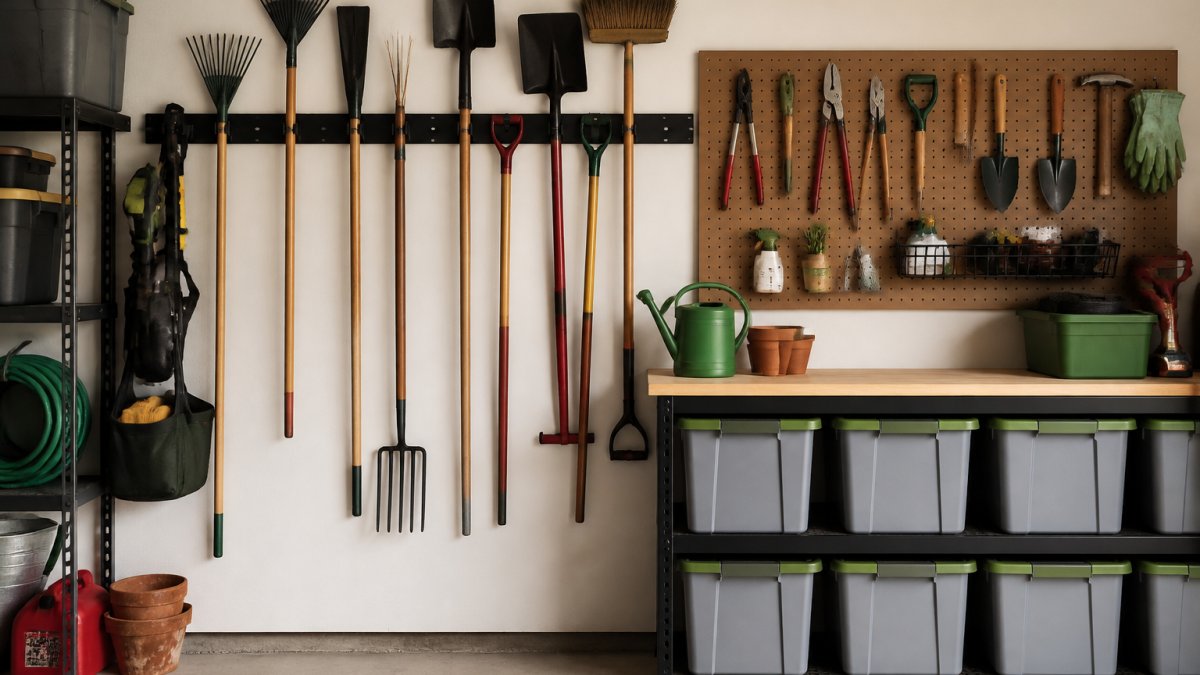
Start with these lawn tool storage ideas:
- Group tools by season so summer gear sits at eye level
- Hang the heaviest items low and close to studs
- Keep walking paths at least 90 centimeters wide
Wall-Mounted Racks and Adjustable Track Systems
A wall-mounted rack is a fixed bar with hooks or brackets. An adjustable track system lets you slide hooks left and right as your tool collection changes. We recommend the track system for anyone who adds tools over time.
Mount tracks into wall studs, not drywall alone. A loaded rack can weigh more than you expect.
Pegboards, Hooks, and Labeled Bins for Small Tools
Pegboards handle the small stuff: hand pruners, gloves, twine, and sprayer nozzles. Add labeled bins for loose items so nothing migrates to the workbench. A simple label maker pays for itself in saved searching time.
Garage Tool Organization for Year-Round Access
Garage tool organization works best when you plan zones before you shop. Divide the garage into a parking zone, a tool zone, and a chemical zone. Then assign storage to each.
Use this simple planning table:
| Zone | What Goes There | Storage Type |
|---|---|---|
| Tool wall | Rakes, shovels, trimmers | Rack or track system |
| Floor corner | Mower, tiller, snow blower | Parking pad or cabinet |
| Shelf | Bins, fluids, spare parts | Labeled bins |
| Locked cabinet | Fuel, chemicals, sharp blades | Lockable metal cabinet |
Keep the most-used items within easy reach. Store ladders and extension cords on dedicated hooks so they do not block the door. A clear path in and out of the garage is a safety feature, not a luxury.
Lawn Mower Storage: Placement, Fuel, and Safety
Lawn mower storage comes down to three things: a level spot, correct fuel handling, and clear access. Park the mower on a flat, dry surface, away from water heaters and pilot lights.
Follow these steps at the end of each season:
- Run the engine until the tank is empty, or add fuel stabilizer
- Clean grass clippings from the deck
- Check the oil and replace the spark plug if needed
- Store the mower under a cover or in a cabinet
Never store a mower with a full tank in a hot, closed space. The U.S. Consumer Product Safety Commission publishes guidance on safe fuel storage and generator use that applies to power equipment too.
For a riding mower, leave enough room to open the hood and reach the battery. You will thank yourself at spring start-up.
Outdoor Garden Tool Storage: Sheds, Cabinets, and Deck Boxes
Outdoor garden tool storage needs three things: a roof, a lock, and airflow. Beyond that, the right choice depends on how much equipment you own, how far the storage sits from the garden, and whether the space is shared. Use the criteria below to pick a type instead of guessing from a product photo.
Match the Storage Type to Your Equipment Inventory
Start with a rough inventory. Count long-handled tools, measure the footprint of your mower or tiller, and note how many small hand tools and chemical containers you keep. Then compare:
| Option | Best For | Typical Footprint | Weather Protection | Security |
|---|---|---|---|---|
| Storage shed | Large tool collections, riding mowers, tillers | 6 ft x 8 ft and up | High when vented and raised | Good with a lock and anchored door |
| Metal cabinet | Small yards, hand tools, chemicals | 2 ft x 3 ft to 4 ft x 6 ft | Medium; check for vents and a raised base | High when bolted down |
| Deck box | Patio and light tools, gloves, pruners | 4 ft to 6 ft long | Medium; look for a gasketed lid | Low to medium |
| Lean-to or carport-style shelter | Mowers and bulky power equipment | Varies | Medium; open sides allow airflow but not security | Low |
A shed earns its cost when you own a riding mower, a tiller, or more than a dozen long-handled tools. A metal cabinet suits a small yard where the only outdoor items are pruners, gloves, and a trimmer. A deck box is convenient but should hold only items you can replace easily, because lids leak and boxes are easy to move.
Siting, Ventilation, and Moisture Control
Pick a shed with a raised floor and vents. Airflow stops condensation, which is the quiet killer of metal tools. Set the shed on a gravel or concrete pad that slopes away from the door so water runs off instead of pooling inside.
A deck box near the patio keeps pruners and gloves close to the garden beds, but move it off the ground on pavers so the bottom does not rot.
Decision Guide for Small, Shared, and Large Spaces
- Small garage or no garage: choose a vertical metal cabinet plus a wall track inside, and a deck box outside for patio tools.
- Shared garage or rental: favor freestanding cabinets and lockable deck boxes that move with you, and avoid drilling into walls you do not own.
- Large yard with a riding mower: a vented shed with a raised floor and a wide door pays off; add a wall track inside for long-handled tools.
Measure the door opening and the path to the storage spot before you buy. A shed that cannot fit through the gate is a expensive mistake.
Protecting Equipment From Moisture, Pests, and Theft
Protection starts with a dry, sealed space. Moisture causes rust. Pests chew through fuel lines and nesting material. Theft is a real risk when expensive power equipment sits in plain view.
Use these habits:
- Wipe metal tools with an oiled cloth before storage
- Store fuel in approved containers, never in open jars
- Seal cracks in shed walls and floors
A motion light and a sturdy padlock deter most casual theft. The U.S. Environmental Protection Agency offers guidance on safe fuel and chemical storage that helps you plan the chemical zone.
Seasonal Preparation and Budget-Friendly DIY Options
Seasonal prep is where most storage plans fail. Tools go in messy in fall and come out rusty in spring. Build a simple end-of-season routine instead, and pair it with low-cost storage you can build or buy without a contractor.
End-of-Season Checklist for Powered Equipment
Your fall checklist:
- Drain fuel from mowers and trimmers, or add fuel stabilizer and run the engine long enough to circulate it
- Clean grass clippings and dirt from decks, undersides, and air intakes
- Sharpen blades and oil metal surfaces with an oiled cloth
Fuel and battery handling matter most. Store fuel only in approved containers, never in open jars, and keep containers out of the house. For battery-powered equipment, follow the manufacturer's guidance on storage charge level; many recommend storing batteries partly charged rather than full or empty.
Budget Ranges and DIY Versus Ready-Made
Costs vary by region and store, but common patterns hold. A sheet of pegboard and a pack of hooks is one of the lowest-cost ways to handle dozens of small tools.
DIY options that work:
- Pegboard plus hooks for hand tools and small parts
- Wood scraps turned into a simple wall rack for rakes and shovels
- Old shelving units with labeled bins for fluids and spare parts
Ready-made options save time and often include load ratings and mounting hardware. Compare the load rating on the box to the weight of your heaviest tool; a rack rated for light garden tools will not hold a loaded trimmer and a shovel together.
A Repeatable Inventory and Labeling System
Long-term organization depends on a system you will actually repeat. Label every bin and shelf by category, not by item: "Mower parts," "Hand tools," "Chemicals," "Seasonal." Keep a written or photographed inventory of serial numbers and purchase dates for power equipment, which helps with warranty claims and theft reports.
If you would rather skip the DIY work, our team at EarthWise Lawn and Landscape LLC handles the maintenance side. You can review current service options and request a quote when you are ready.
Frequently Asked Questions
What are some ideas for storing lawn equipment?
Start with vertical storage: a wall-mounted rack or adjustable track system holds rakes, shovels, and brooms off the floor. Hang long-handled tools by the head so handles stay straight. Store power equipment like mowers and tillers at floor level near the door for easy access. Small items such as sprayers, extension cords, and gloves go into labeled bins on shelves. A pegboard handles hand tools, and a deck box or storage cabinet keeps outdoor garden tools dry. The goal is one clear zone per equipment type so you can find and return items quickly.
How should you store a lawn mower when it is not in use?
Park the mower on a level, dry surface, ideally on a mat or pallet to keep moisture off the deck. Run the fuel tank low or add a fuel stabilizer before long storage periods, and disconnect the spark plug before any cleaning or blade work. Keep the mower away from water heaters, furnaces, and other ignition sources since gasoline vapors are flammable. In winter, store it in a garage or shed with the battery removed and on a trickle charger if it is electric start. Cover it to keep dust and pests out.
How can you organize long-handled lawn tools in a garage?
Use a heavy-duty wall rack rated for the combined weight of your tools, mounted into studs at a height you can reach without a ladder. Hooks should hold each tool by the head or a dedicated loop so handles do not warp. An adjustable track system lets you rearrange hooks as your equipment changes. Keep the most-used tools, like the rake and shovel, closest to the door. Group tools by season so winter items move to the back and summer tools stay within reach. This is the core of practical garage tool organization.
What is the best way to protect lawn equipment from moisture?
Store equipment in a dry, ventilated space and keep it off bare concrete, which wicks moisture. Use pallets, rubber mats, or shelving. Wipe metal surfaces dry after use and apply a light coat of oil to bare steel blades and tines. In sheds, add vents or a small dehumidifier, and seal gaps where pests enter. For outdoor garden tool storage, choose a cabinet or deck box with a tight lid and raised base. Drain fuel lines and sprayers before winter, and check stored equipment monthly for rust or rodent nests.
Good storage protects your tools. A healthy lawn protects your property value. If your weekends are already full, EarthWise Lawn and Landscape LLC can take the mowing, trimming, and cleanup off your list. We bring more than 30 years of hands-on experience, professional equipment, and consistent service to every visit. Get a quote from EarthWise Lawn and Landscape LLC and keep your outdoor space looking polished all season.