 how-to
Lawn Service Satisfaction Guarantee Explained (2026 Guide)
Table of Contents
- What a Satisfaction Guarantee Actually Covers
- Lawn Care Company Red Flags That Void Your Guarantee
- Hiring a Professional Lawn Service Checklist
- How to Resolve Lawn Care Service Disputes Step by Step
- Refund vs. Re-Service: Which Remedy to Ask For
- The 'Bad Faith' Clause: When Guarantees Get Denied
- What to Look For in a Lawn Service Agreement
- Frequently Asked Questions
Last Updated: October 4, 2026
What a Satisfaction Guarantee Actually Covers
Most homeowners read "satisfaction guaranteed" and hear "we will make it right, always." The fine print says something narrower. A guarantee usually covers the quality of the work performed: an uneven cut, missed trimming, or a botched edge.
That gap is where nearly every dispute starts. The FTC's consumer guidance on service contracts is clear that the written terms, not the sales pitch, control the deal.
Service vs. Outcome: The Distinction That Decides Your Claim
Service guarantees cover how the work was done; outcome guarantees cover what the lawn looks like afterward.
A service guarantee says: we will mow at the proper height, use sharp blades, trim the edges, and clean up the clippings.
An outcome guarantee says: your lawn will be weed-free, thick, and green.
| Guarantee Type | What It Covers | Typical Remedy | Hard to Claim? |
|---|---|---|---|
| Service guarantee | How the work was done | Re-service | No |
| Outcome guarantee | Final lawn appearance | Refund or re-service | Yes |
| Weed control guarantee | Specific weeds return | Re-treat | Sometimes |
| Damage guarantee | Property harmed by crew | Repair or pay | No |
Most lawn care companies offer a service guarantee, not an outcome guarantee.
Lawn Care Company Red Flags That Void Your Guarantee
A guarantee does not disappear because a company decides it should. It disappears because a specific contract term was triggered. Each red flag below maps to a clause that can quietly cancel your coverage later.
- No written guarantee at all. A verbal promise is nearly impossible to enforce. Under the statute of frauds in most states, contracts that cannot be performed within one year must be in writing, and an open-ended guarantee can fall into that trap. If it is not on paper, assume it does not exist.
- Vague language with no remedy. "We stand behind our work" names no remedy, no time limit, and no claim process. A guarantee needs all three to be enforceable. Ask the company to write the remedy into the agreement: re-service, credit, or refund.
- Guarantee voided by missed payments. Many contracts cancel coverage the moment a bill is late, sometimes by a single day. Read the payment and guarantee clauses together, and ask whether a grace period applies.
A guarantee that is impossible to claim is not a guarantee, it is marketing. The test: can you point to the clause naming the remedy, the window, and the process?
Hiring a Professional Lawn Service Checklist
Use this list before you hire anyone. It takes ten minutes and prevents most disputes.
- Get the guarantee in writing, with a clear time limit for claims
- Confirm the company carries liability insurance and workers' comp
- Ask for the license number if your state requires one
That last item matters more than people think: a text confirming a service change is part of the record.
How to Resolve Lawn Care Service Disputes Step by Step
Resolve a lawn care dispute by reporting the problem in writing, within the guarantee window, with photos and dates. Start with the crew supervisor, then move up. Keep every message.
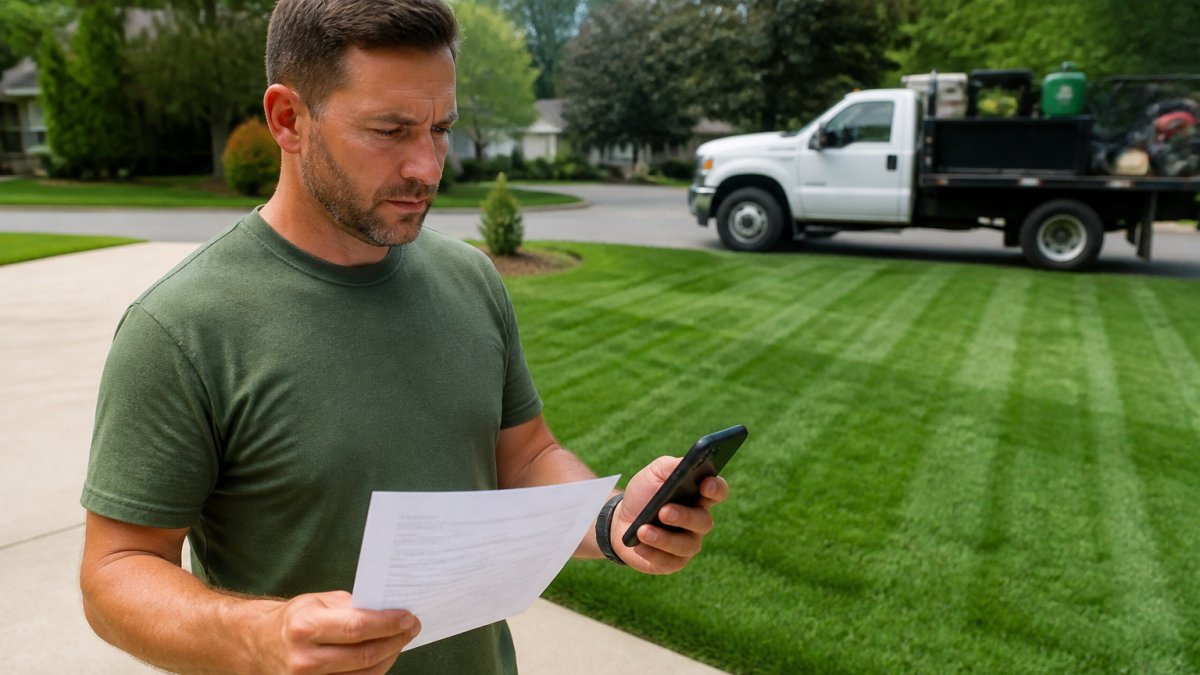
The order matters. Skipping a step weakens your position if the case ever goes further.
- Document the problem the same day. Photograph the missed strip, the scalped patch, or the uncut edge.
- Check your guarantee window. Many contracts require notice within a set number of days.
- Contact the company in writing. Email or text beats a phone call because it creates a record.
- State the remedy you want. Ask for a re-service or a refund, not both.
- Give them a reasonable window to respond. A week is standard.
- Escalate if nothing happens. Move to a supervisor, then the owner.
The Documentation Checklist: What to Save Before You Call
Gather these before your first call, so you are not scrambling later.
- Photos with timestamps of the problem area
- Your signed service agreement
- The written guarantee, if it is a separate page
A claim with photos and a paper trail resolves faster than one that relies on memory.
Escalation Paths: From Supervisor to Small Claims Court
If the company will not budge, you have options, and they go in order.
Start with the crew supervisor, then the account manager, then the owner. Give each a written summary and a deadline.
If that fails, file a complaint with your state's consumer protection office or the agency that licenses home service contractors.
For money you are owed, small claims court is the last stop.
Refund vs. Re-Service: Which Remedy to Ask For
Ask for a re-service first in almost every case. Ask for a refund when the problem is repeat, the damage is real, or you have lost trust in the crew. The two remedies are not interchangeable, they carry different costs, timelines, and risks for both sides.
What Each Remedy Actually Costs the Company
A re-service costs the company labor, fuel, and a slot on the schedule. A refund costs the full contract price plus labor already spent.
For you, the trade-off runs the other way. A re-service is faster and keeps the relationship intact, but depends on the same crew doing better the second time. A refund ends the relationship and returns cash, but can take weeks and may require proving the service was not delivered at all.
When a Refund Is the Right Ask
A refund makes sense when:
- The same problem has happened three or more times, and the company has already had a chance to correct it
- The crew damaged plants, sprinklers, hardscaping, or a vehicle, and the damage exceeds the value of the service
- The company missed multiple visits without notice and still billed you
Many contracts offer re-service only, with refunds reserved for specific cases. Read that clause before you argue. If the contract says re-service, pushing for a full refund may not work. But if the company failed to deliver the service at all, a refund is a fair ask, and in some states, failure to deliver a paid service can trigger consumer protection remedies beyond the contract.
When a Re-Service Fails: The Escalation Path
This is the part most guides skip. If the re-service does not fix the problem, you are no longer in a simple customer service conversation. You are in a dispute, and the order of escalation matters.
- Document the failed re-service the same day. Photograph the same area from the same angle if possible. A before-and-after pair is far stronger than a single image.
- Send a written notice of failed cure. State that the re-service did not resolve the issue, reference the original claim date, and ask for a specific remedy, a second re-service, a credit, or a refund.
- Escalate to the owner or general manager. Account managers often lack authority to issue refunds. Ask directly who can authorize one.
- File a complaint with your state's consumer protection office or the licensing board that regulates home service contractors. Many states require a license for lawn care work, and a licensing board can act on a valid complaint. The complaint itself often prompts resolution faster than another phone call.
- Consider third-party mediation or arbitration if the contract requires it. Many service agreements include a mandatory arbitration clause. Read it before you file in court, because it may limit where and how you can pursue the claim.
- Small claims court is the last stop. Most states cap small claims at a few thousand dollars, and you do not need a lawyer. Check your state court's website for the current filing limit and fee, since these vary by state and change over time.
The Remedy You Should Ask For First
Match the remedy to the failure. A missed strip or uneven cut is a service failure, ask for a re-service.
If the company offers a credit instead of a refund, treat it as a refund with a condition: the credit is only worth what you will actually spend with that company. If you plan to cancel, a credit is worth nothing.
The 'Bad Faith' Clause: When Guarantees Get Denied
A bad faith clause lets a company deny a claim if it believes the customer acted dishonestly.
Common triggers include:
- Filing a claim after the reporting window closed
- Refusing to let the crew back on the property to fix the issue
- Stopping payment while still asking for service
Here is the part most homeowners miss: a company cannot deny a valid claim just because it feels the customer was difficult.
That single question resolves a surprising number of disputes, because it forces the company to either name the clause or back down.
What to Look For in a Lawn Service Agreement
Read the agreement for these specific items before you sign. Each decides whether your guarantee is real or decorative.
- The guarantee clause. Look for the remedy, the time limit, and the conditions.
- The scope of work. What is included, and what costs extra.
- The claim process. How to report a problem and to whom.
- The payment terms. When payment is due and what happens if it is late.
A solid agreement names a remedy, sets a clear window, and tells you exactly how to file a claim. If any are missing, ask for them in writing before you sign.
With more than 30 years of hands-on experience and a family tradition built on hard work and integrity, we mow at proper heights with sharp blades, vary our patterns, and handle trimming and cleanups with professional equipment.
Frequently Asked Questions
What does a 100% satisfaction guarantee actually cover in lawn care?
Most guarantees cover the quality of the work performed, not the outcome you hoped for. A satisfaction guarantee typically promises that mowing, trimming, and cleanup will meet the service standards in your agreement. It usually does not cover brown patches from drought, disease, or grub damage. Read the scope of work carefully: if the contract lists specific tasks and frequencies, those are what the guarantee backs.
What are some red flags when hiring a lawn care service?
Watch for companies that refuse to put guarantees in writing, demand full payment upfront, or cannot provide proof of professional licensing and insurance. Other red flags include no physical business address, high-pressure same-day signing discounts, and contracts that let the provider change the service window without notice. A written commitment with clear terms and conditions protects you far better than a verbal performance promise.
How do I file a claim if I am unhappy with my lawn service?
Report the issue within the time limit stated in your contract, usually 24 to 72 hours after service. Document the problem with dated photos, note your service agreement number, and submit the claim in writing by email so you have a record. Most providers will schedule a site inspection and offer re-service or a partial refund. If the dispute continues, request escalation to a supervisor and keep every message.
Are satisfaction guarantees legally binding for service providers?
A written guarantee is part of your service agreement and is generally enforceable as a contractual obligation under state consumer protection laws. That said, most guarantees include conditions: you must report the issue within a set window, keep up with watering or maintenance requirements, and allow the company a chance to fix the problem first. Verbal promises are much harder to enforce, which is why a written commitment matters.
A guarantee is only as good as the company behind it. Before you sign, ask who shows up, what happens if you are unhappy, and how fast they respond. EarthWise Lawn and Landscape LLC answers those questions up front, with written terms, consistent crews, and more than 30 years of experience keeping properties clean, healthy, and well-maintained. Get a quote from EarthWise Lawn and Landscape LLC and see the difference a dependable crew makes.