 Comparison
Small vs Large Lawn Companies: Which Fits Your Property
Last Updated: October 26, 2026
Quick Summary
Small vs large lawn companies differ primarily in communication style and service scope: small, owner-operated companies offer personalized service and direct communication with consistent crew members, while large national providers deliver standardized processes, backup coverage, and broader service options. Your choice depends on your property size, maintenance needs, and whether you prioritize personalized attention or comprehensive service offerings.
- Properties under 5,000 square feet with straightforward lawn care typically work well with small local companies.
- Large companies offer broader service menus including landscape design, hardscaping, and seasonal planting alongside lawn maintenance.
- Small companies usually have lower overhead and faster response times, while large providers have built-in redundancy and backup staff.
- National average lawn maintenance costs range from $124-$407 per visit depending on property size and service frequency.
- Always request written estimates from at least two companies and verify references before hiring.
Table of Contents
- Small vs Large Lawn Companies: Key Differences at a Glance
- How to Choose a Lawn Care Company Based on Property and Service Needs
- Questions to Ask a Lawn Care Company Before Hiring
- Local Lawn Care Company vs National Provider: Reliability and Accountability
- Lawn Care Service Comparison Checklist: Written Estimates and References
- Cost Transparency: Small-Company vs Large-Company Pricing Models
- Getting Your Free Quote from EarthWise Lawn and Landscape LLC
- Frequently Asked Questions
Small vs Large Lawn Companies: Key Differences at a Glance
Choosing between a small and large lawn company isn't just about price. The real difference lies in how each operates and how they fit your property. Small, owner-operated companies typically offer personalized service and direct communication, while national providers bring standardized processes, backup coverage, and broader service options. The best choice depends on what your yard actually requires.
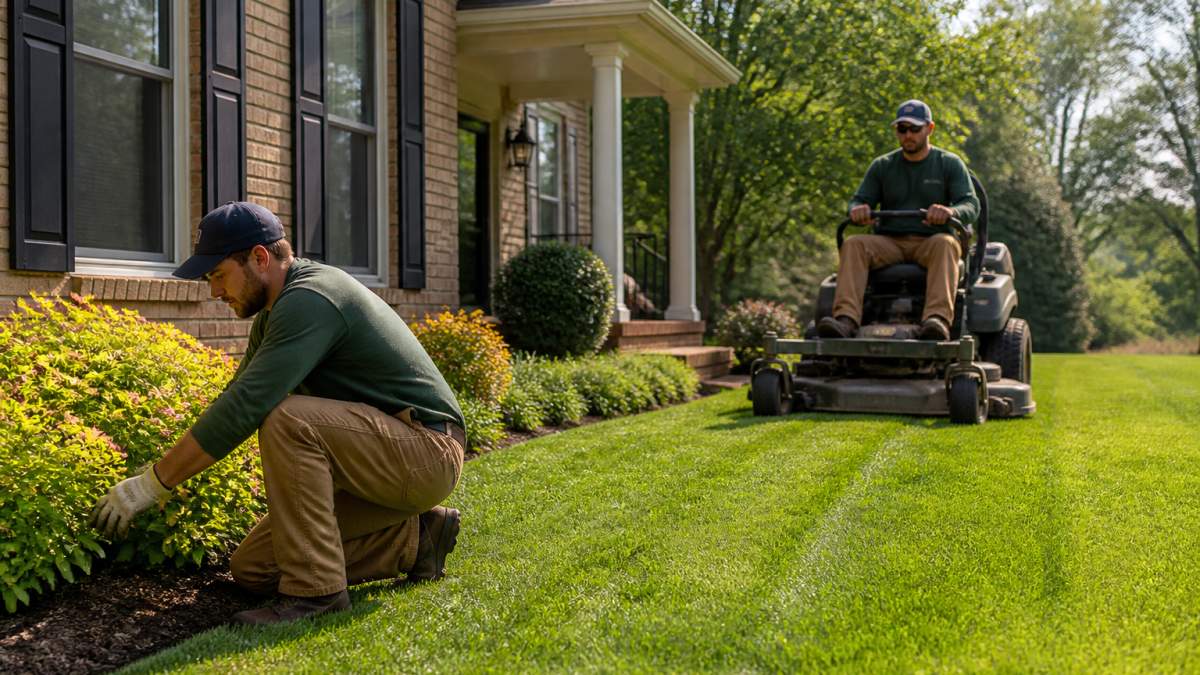
The distinction between small and large lawn companies goes deeper than team size. A small company handles every project with direct owner involvement, so you often communicate with the same person working on your property.
Here's what separates them most clearly:
| Aspect | Small Company | Large Company |
|---|---|---|
| Communication | Direct with owner/manager | Through account manager |
| Crew consistency | Same people each visit | May rotate crew members |
| Service options | Core lawn care focus | Full landscaping + design |
| Equipment | Professional but specialized | Extensive fleet |
| Flexibility | High; adapts to your needs | Standardized schedules |
| Response time | Fast; owner-driven | Depends on workload |
| Pricing model | Per-job or flat-rate | Tiered packages |
| Backup coverage | Limited | Built-in redundancy |
How to Choose a Lawn Care Company Based on Property and Service Needs
Your property's size, layout, and maintenance requirements should drive your decision. A quarter-acre suburban lot has different needs than a complex multi-acre property with mature trees, slopes, and intricate garden beds. The right company, whether small or large, matches your property's specific demands.
Assessing Your Property Size and Maintenance Scope
Start with the basics: how many square feet are you maintaining, and what does your landscape include? A property under 5,000 square feet with straightforward lawn and basic trimming often works perfectly with a small, local company.
Properties between 5,000 and 8,000 square feet sit in a middle zone, with multiple lawn areas, varied terrain, or mixed landscaping. Both small and large companies can serve this range, but your specific features matter.
Larger residential properties over 8,000 square feet, or commercial landscaping, often benefit from a large company's resources: multiple crew members working simultaneously, on-site equipment, and backup systems. However, some high-end homeowners prefer small companies precisely because they want meticulous, personalized attention on premium properties.
Matching Company Capabilities to Your Project Requirements
Beyond square footage, consider what services you actually need. Do you want mowing only, or mulching, hedge trimming, seasonal cleanups, and minor landscaping adjustments?
Large companies offer broader service menus: landscape design, hardscaping, seasonal planting, pest management, and irrigation systems. If your vision includes redesigning front beds or adding a patio, a large provider may be more efficient, with specialists on staff who can coordinate multiple trades.
However, don't assume bigger means better for everything. A small company invested in your property's long-term appearance often delivers sharper attention to detail, noticing when your lawn needs different mowing heights due to weather or when hedges need trimming at exactly the right time.
Questions to Ask a Lawn Care Company Before Hiring
Before signing any agreement, get clarity on how the company operates and whether they'll meet your expectations.
Ask directly: Who will be handling my property, and will it be the same person each time? For small companies, this is usually yes.
How do you handle weather delays or scheduling conflicts? A small company might reschedule you themselves.
What's included in your standard service, and what costs extra? Some companies include basic cleanup and minor debris removal. Others charge separately.
How do you communicate about issues or changes? Can you reach someone directly to adjust your schedule, or does everything go through a phone line?
What happens if I'm not satisfied with the work? Ask about their approach to quality concerns.
Local Lawn Care Company vs National Provider: Reliability and Accountability
Reliability and accountability aren't guaranteed by company size; they're driven by how a company operates and what systems they've built.
A local small company's reputation lives in your neighborhood. If they do poor work, word spreads fast. That's powerful accountability.
However, small companies have limits. If the owner gets sick or the crew member assigned to your property quits, you might experience service gaps. They can't always offer backup coverage.
National providers have systems designed for reliability at scale: crew schedules, backup staff, and equipment redundancy. If your assigned crew is unavailable, another covers your property.
The trade-off: standardization can feel impersonal. Your property is one of hundreds. If something goes slightly wrong, you navigate a customer service system rather than talking directly to the decision-maker.
Service Consistency and Staff Continuity
Staff turnover is a real issue in lawn care, especially at large companies where crew members are employees rather than owner-operators. This affects you directly: new crew members may not know your property's quirks, your preferred mowing pattern, or which areas need extra attention.
Small companies typically have lower turnover because the owner is usually the primary technician or they employ a small core team over many years.
Large companies try to mitigate turnover through documentation and training. Your property's details get recorded in their system so any crew can reference them. This works reasonably well, but it's not the same as personal knowledge built over years.
Insurance, Licensing, and Worker Protections
When someone's on your property regularly, you need to know they're properly insured and licensed.
Ask any company, small or large, for proof of general liability insurance and worker's compensation coverage. Small companies sometimes operate without full coverage, exposing you to liability if someone gets injured on your property.
Licensing requirements vary by state, but many require lawn care companies to be licensed. Ask for their license number and verify it with your state's licensing board if one exists.
Worker protections matter too. Employees at large companies are typically covered by worker's compensation and employment laws; independent contractors hired by small companies may not be. If someone gets hurt, the liability chain differs. This isn't a reason to avoid small companies, but it's a question to ask.
Lawn Care Service Comparison Checklist: Written Estimates and References
Before you decide, get everything in writing and verify the company's track record.
Request written estimates from at least two companies. A good estimate includes the exact services provided, frequency (weekly, bi-weekly, monthly), the service area in square feet or clear description, pricing, and any seasonal adjustments. Compare these directly.
Ask for references. Call at least two homeowners currently using the service. Ask them: Does the company show up consistently? Is the quality consistent? Have they had any issues, and how were they resolved?
Check online reviews on Google, Yelp, and the Better Business Bureau. Look for patterns. One negative review happens to any company. Multiple complaints about the same issue, missed appointments, poor communication, quality problems, is a warning sign.
Visit a property the company is currently maintaining if possible. You can often see their work quality directly: are lawns evenly mowed, are edges trimmed cleanly, does the property look maintained or neglected?
Cost Transparency: Small-Company vs Large-Company Pricing Models
Pricing differs significantly between small and large providers, and understanding why helps you evaluate value.
Large companies typically offer tiered packages: a basic plan with weekly mowing, a mid-tier adding mulching and minor trimming, a premium tier including seasonal services.
According to Real Green's lawn care pricing analysis, the industry uses three main pricing models: hourly rates (typically $30-$65 per hour), per-square-foot rates (roughly $0.01-$0.05 per square foot), and flat monthly rates. Small companies often use flat rates because it's simpler to manage. Large companies mix models depending on the service.
A Thumbtack's lawn service pricing report indicates a national average hiring range of $124-$407 for standard lawn maintenance visits.
Small companies often have lower overhead. Large companies have higher operational costs, office staff, customer service, fleet maintenance, which gets passed to you.
Don't choose based on price alone.
Getting Your Free Quote from EarthWise Lawn and Landscape LLC
When you're ready to evaluate your options, EarthWise Lawn and Landscape LLC offers a straightforward process.
Our approach reflects what small, owner-operated companies do well: direct communication, personalized attention, and consistency.
We're transparent about what's included in our service and how we price it. You'll know exactly what you're paying for and what to expect. Get a quote from EarthWise Lawn and Landscape and see how our approach compares to other options you're evaluating.
The choice between small and large lawn companies comes down to your property's needs, your communication preferences, and your priorities around consistency and service scope. Small companies excel at personalized, reliable core lawn care; large providers offer broader services and backup coverage.
Choosing the right lawn care company shapes how your property looks every week. The wrong choice, whether too small to handle your needs or too large and impersonal, creates ongoing frustration.
Frequently Asked Questions
What are the main advantages of hiring a small lawn care company over a large one?
Small lawn companies typically offer personalized attention, direct communication with the owner or manager, and flexibility in scheduling around your needs. They often handle smaller and oddly-shaped properties more thoughtfully, use less equipment that may better suit tight spaces, and provide consistent service from the same team. Small companies also tend to understand local property conditions better and may adjust services seasonally based on neighborhood needs.
Are small lawn companies more affordable than large companies?
Pricing varies by company regardless of size, but small companies often have lower overhead costs, which can translate to competitive pricing. However, cost alone shouldn't drive your decision. Large companies may offer package discounts or bundled services, while small companies might charge less for customized, smaller-scope work. Request written estimates from both to compare fairly. Remember that the cheapest option isn't always the best value if reliability, experience, or service quality suffers.
How do I know if a lawn care company is reliable before signing a contract?
Check references from current and past customers, read online reviews on multiple platforms, verify licensing and insurance coverage, and ask how long they've served the community. Inquire about trial services or single visits before committing to a contract. Ask about their backup coverage if your regular crew is unavailable, and clarify their cancellation policy. A reliable company will provide detailed written estimates, show up on time, communicate clearly, and stand behind their work with a satisfaction guarantee.
Should I choose a local lawn care company or a national provider?
Local companies often provide more personalized service, direct access to decision-makers, and familiarity with neighborhood conditions and soil types. National providers offer standardized processes, larger teams for bigger projects, and established corporate accountability structures. For small to medium residential properties, a local company typically excels at customization and communication. For large commercial properties or those requiring specialized equipment and crews, national providers may have advantages. Evaluate based on your property size, service complexity, and preference for personal relationships versus corporate consistency.
What should I look for in a lawn care service comparison checklist?
Compare written estimates (not verbal quotes), years of experience and qualifications, references from similar-sized properties, insurance and licensing verification, equipment used and maintenance standards, service frequency options, communication methods and response times, cancellation and contract terms, and any satisfaction guarantees or trial periods offered. Also assess how they handle seasonal adjustments, whether the same crew returns each visit, and how they handle weather delays. Request details about mowing heights, blade sharpness, pattern variety, and any additional services like mulching or trimming included in their standard offering.