 How-to
Lawn Care with Professional Equipment: Benefits Guide
Table of Contents
- Why Lawn Care with Professional Equipment Benefits Your Yard
- Professional Lawn Care Equipment: What Separates It from Homeowner Gear
- Proper Mowing Height for Grass: The One-Third Rule in Practice
- Lawn Mowing Patterns That Improve Lawn Health and Appearance
- Professional Lawn Care vs DIY: A Transparent Cost and Time Comparison
- How to Evaluate a Provider's Equipment and Service Quality
- What Professional Equipment Cannot Do: Setting Realistic Expectations
- Conclusion: Getting Consistent, Professional Results
- Frequently Asked Questions
Last Updated: October 12, 2026
Why Lawn Care with Professional Equipment Benefits Your Yard
Lawn care with professional equipment benefits a property in ways homeowner gear rarely matches: cleaner cuts, healthier grass, and far less strain on the operator.
Professional lawn care equipment is built for repeated commercial use, with sharper cutting systems, stronger engines, and calibration that keeps results consistent visit to visit. Homeowner mowers cut the same lawn but dull faster, clog more often, and leave a rougher finish.
Below, we break down which tools improve which tasks, how mowing height and patterns affect lawn health, and how to weigh DIY against hiring a crew. If a neighbor's yard looks sharper with seemingly no effort, the answer is usually the equipment and the habits behind it.
Professional Lawn Care Equipment: What Separates It from Homeowner Gear
Professional lawn care equipment separates from homeowner gear in three areas: build quality, cutting precision, and durability under constant use. A commercial walk-behind mower runs a heavier deck and larger engine than a push mower, keeping blade speed steady through thick, wet grass, the steadiness that produces a clean cut instead of a torn one.
The clearest way to see the difference is to match the tool to the job, since each task stresses grass differently.
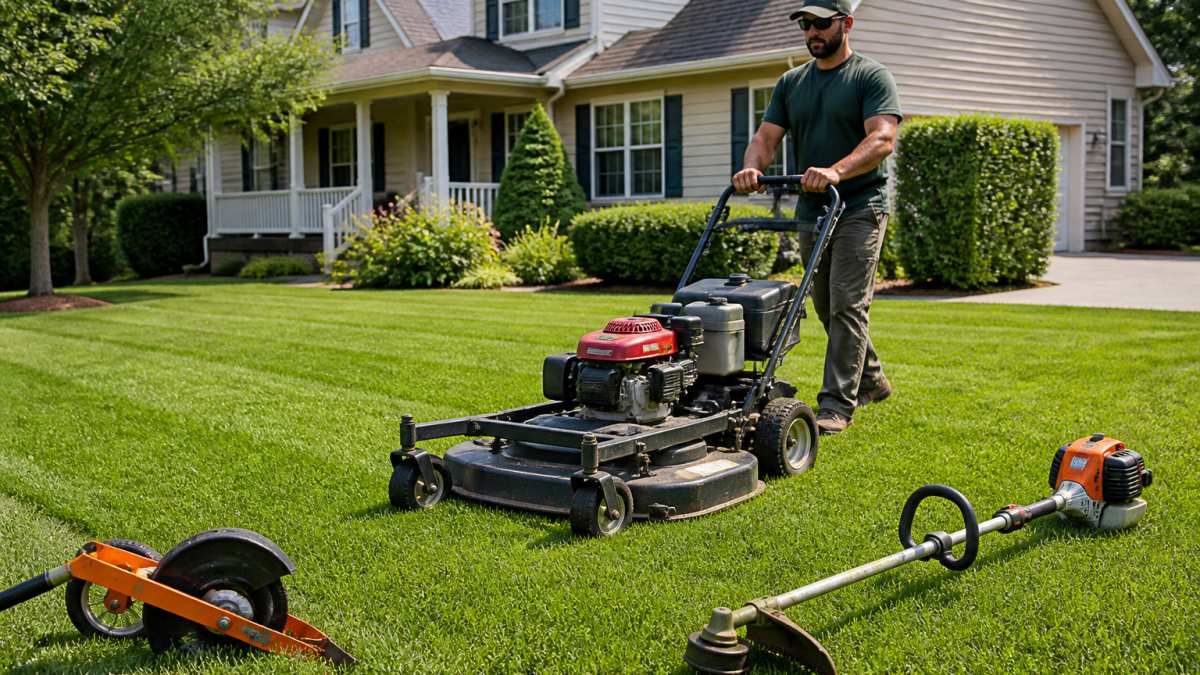
Matching Equipment to the Task
- Mowing: A commercial mower with a sharp, balanced blade and a deck that holds cutting height delivers an even cut. Deck size and horsepower matter on large or irregular lawns, where homeowner mowers bog down and leave stragglers.
- Edging: A dedicated stick edger with a hardened blade cuts a clean trench along driveways and walkways. A string trimmer turned sideways approximates it, but the line frays and the bed line wanders.
- Trimming: A commercial string trimmer with a straight shaft reaches under fences, around trees, and along foundations without the operator leaning into the work.
- Aeration: A core aerator pulls plugs of soil to relieve compaction. This is a task most homeowners cannot replicate with a spike aerator, which pushes soil aside rather than removing it.
- Fertilizing: A calibrated rotary or drop spreader applies product at a consistent rate. An uncalibrated one drops too much in one strip and too little in the next, showing up as uneven color and patchy growth.
- Debris removal: A backpack blower clears clippings, leaves, and trimmings from beds, walks, and driveways so the finished lawn reads as clean rather than half-done.
Calibration, Maintenance, and Sharp Mower Blades
Sharp mower blades and calibrated equipment keep results consistent week to week. A dull blade tears grass instead of slicing it, leaving a ragged tip that browns and invites disease. We sharpen blades on a set schedule and check spreader output before every application.
Maintenance extends beyond blades. Air filters, spark plugs, oil, and belts all affect how a mower holds blade speed under load, and a machine that loses RPM in tall grass leaves an uneven cut no matter how skilled the operator is. Scheduled servicing keeps a commercial mower performing like one.
Safety and Environmental Considerations
Commercial equipment is more powerful, which makes safe operation a real responsibility. Operators should wear eye and ear protection, keep bystanders clear of discharge, and never service a hot engine. Fuel rules are common sense: no refueling near an ignition source, no running a mower in an enclosed space.
On the environmental side, properly maintained equipment runs cleaner and cuts more efficiently. When a provider applies fertilizer or weed control, responsible practice means calibrating the spreader, following label rates, and keeping product off hard surfaces where it can run off. EPA guidance on responsible lawn and garden practices is a useful reference for what to expect.
Proper Mowing Height for Grass: The One-Third Rule in Practice
The proper mowing height for grass follows the one-third rule: never remove more than one-third of the blade at a single cut. Cutting more than that shocks the plant, stalls root growth, and opens the door to weeds and disease.
That rule drives frequency and setup. Let grass grow tall and scalp it in one pass, and you get a brown, stressed lawn no matter how good the mower is. Taller grass also shades the soil, slowing moisture loss and crowding out weeds.
- Cool-season grasses: keep the deck higher during summer heat stress
- Warm-season grasses: adjust down slightly during active growth, then raise before dormancy
- Shade: mow taller than you would in full sun to compensate for weaker growth
Seasonal adjustments matter: the right height in spring is rarely right in August.
Lawn Mowing Patterns That Improve Lawn Health and Appearance
Lawn mowing patterns improve lawn health by changing direction regularly. Grass blades lean the way they're pushed, so mowing the same direction weekly trains the lawn to lean, dulling the appearance and stressing the plant.
Varied patterns also prevent ruts and soil compaction. A simple rotation works well:
- Week 1: straight lines, north to south
- Week 2: straight lines, east to west
- Week 3: diagonal pass
- Week 4: reverse diagonal
This rotation keeps the cut clean and helps the grass stand up straighter. University turfgrass extension guidance on mowing practices notes that alternating direction also reduces wear patterns and improves overall turf density over time.
Professional Lawn Care vs DIY: A Transparent Cost and Time Comparison
Professional lawn care vs DIY comes down to more than a mower's sticker price. The honest comparison includes equipment, fuel, maintenance, storage, and your weekly hours. Most homeowners compare a mower's price to a service's price and stop there, which is why DIY usually looks cheaper than it is.
Equipment Purchase, Fuel, and Operating Costs
Equipment purchase is only the first line in the DIY ledger. A capable mower, trimmer, edger, and blower add up fast, before fuel, oil, replacement blades, and repairs, and operating costs continue every season, whether or not you feel like mowing.
A useful way to frame it is to list every cost a homeowner actually absorbs:
- Upfront equipment: mower, string trimmer, edger, blower, and any attachments such as a bagger or aerator
- Consumables: fuel, oil, two-cycle mix, trimmer line, and replacement blades
- Maintenance: blade sharpening, air filters, spark plugs, belts, and annual service
- Repairs: carburetor work, starter cords, and deck rust, which tend to appear after a few seasons
- Storage: garage or shed space that could hold something else
- Time: mowing, trimming, edging, blowing, fueling, and hauling equipment for service
| Cost Category | DIY Ownership | Professional Service |
|---|---|---|
| Upfront equipment | Mower, trimmer, edger, blower | None |
| Fuel and oil | Ongoing each season | Included in service |
| Blade sharpening | Your time or a shop fee | Handled by provider |
| Storage space | Garage or shed required | Not needed |
| Time per week | One to three hours | None |
Pricing for a professional plan depends on lawn size and service frequency, so we quote each property individually. You can review current options on our website.
Time Savings and Labor Savings
Time savings are the benefit most homeowners notice first. A full cut, trim, edge, and cleanup takes a trained crew far less time than a homeowner working alone, and the savings compound across a season. Two hours a week on the lawn is roughly a hundred hours per mowing season, before trips for fuel, blades, or repairs.
That reclaimed time is the real trade: a finished lawn without lifting the equipment.
How to Evaluate a Provider's Equipment and Service Quality
Evaluating a provider's equipment and service quality starts with two questions: what do they cut with, and how do they maintain it. A crew running commercial-grade tools on a sharpening schedule produces a cleaner cut than one squeezing a homeowner mower through a full route.
Use this checklist before you hire anyone:
- Ask what mowers and trimmers they run, and whether the equipment is commercial-grade
- Ask how often blades are sharpened and equipment is serviced
- Confirm they vary mowing patterns rather than cutting the same direction weekly
- Ask how they handle edging, trimming, and debris removal
- Confirm they adjust mowing height and service frequency by season
- Get the service plan in writing, including visit frequency
Safety and environmental considerations belong on this list too. Properly maintained equipment runs cleaner and cuts more efficiently, and a provider who handles fertilizer and weed control should be able to explain how they calibrate spreaders and manage product use. EPA guidance on responsible lawn and garden practices is a useful reference for what to expect.
What Professional Equipment Cannot Do: Setting Realistic Expectations
Professional equipment cannot fix a lawn with deeper problems. If soil is compacted, drainage is poor, or the grass is wrong for the light it gets, better mowing alone won't turn it around.
Equipment improves how a lawn is cut, edged, and maintained. It doesn't replace aeration, overseeding, weed control, or soil correction when those are the real issues. A good provider will tell you which category you're in rather than promising a miracle from a mower.
Realistic expectations look like this: a healthier, more even lawn with a cleaner finish, improving over a full season rather than overnight. USDA resources on soil health and lawn management explains why soil condition sits underneath everything else you do above ground.
Conclusion: Getting Consistent, Professional Results
A lawn that looks sharp every week comes down to the right equipment, sharp blades, correct mowing height, and varied patterns on a consistent schedule. Most homeowners don't have the time or commercial-grade tools to keep that up.
EarthWise Lawn and Landscape LLC brings more than 30 years of hands-on experience and a family tradition rooted in hard work and integrity to every property. We mow at proper heights with sharp blades, vary our patterns, and handle trimming, mulching, and minor cleanups with professional equipment for a polished finish.
Get started with EarthWise Lawn and Landscape LLC and keep your property looking clean, healthy, and well-maintained without lifting a finger.
Frequently Asked Questions
How does professional lawn care equipment improve lawn health?
Commercial mowers hold a consistent cutting height and run sharp, balanced blades, which produce clean cuts instead of torn grass tips. Torn tips lose moisture and invite disease, while clean cuts heal faster. Pros also calibrate spreaders for even fertilizer and treatment application, so no section gets over- or under-fed. The result is steadier grass growth, better soil health, and fewer bare or patchy spots over a season.
What is the one-third rule in lawn care?
The one-third rule means never removing more than one-third of the grass blade in a single mowing. Cutting more than that stresses the plant, weakens roots, and can leave clippings thick enough to smother the lawn. Following it keeps grass growth steady and helps clippings break down naturally as mulch. It also sets the proper mowing height for grass, which shifts with the season and grass type.
Is professional lawn care worth it compared with doing it yourself?
It depends on how you value your time and what equipment you already own. A quality mower, trimmer, edger, and spreader plus fuel, maintenance, and storage add up, and most homeowners still mow less consistently than a scheduled service. Professional lawn care vs DIY often comes down to consistency: weekly visits, sharp blades, and varied mowing patterns produce a more even, healthier lawn than occasional weekend mowing.
What should I look for when hiring a lawn care service?
Ask what equipment they use and how often blades are sharpened, whether spreaders are calibrated, and how they adjust mowing height and patterns through the season. Confirm service frequency, what happens if a visit is missed, and whether they carry insurance. For a smaller local provider, ask who will actually show up each visit. A short walkthrough of your property before the first cut tells you more than any brochure.