 How-to
How to Sharpen Lawn Mower Blades at Home Safely
Last Updated: November 19, 2026
Quick Summary
To sharpen lawn mower blades at home, disconnect the spark plug or remove the battery, clamp the blade in a vise, and file the cutting edge at the original bevel angle until a slight burr forms. Sharpen both ends equally, remove the burr, then balance the blade before reinstalling it.
- Disconnect the spark plug boot before touching the blade to prevent accidental starts.
- Tilt a gas mower with the air filter and carburetor facing up to avoid oil damage.
- File in one direction away from the edge and follow the factory bevel angle.
- Stop filing when a slight burr curls over the back of the edge.
- Rebalance the blade on a nail or balancer until it hangs level.
Table of Contents
- Why a Dull Blade Ruins Your Lawn (and Your Mower)
- Lawn Mower Blade Sharpening Tools and Safety Gear
- How to Remove the Blade Safely by Mower Type
- How to Sharpen Lawn Mower Blades by Hand: File and Grinder Steps
- How to Balance a Lawn Mower Blade After Sharpening
- How Often to Sharpen Lawn Mower Blades and When to Replace Them
- Mulching, Standard, and High-Lift Blade Differences
- Troubleshooting Vibration and Uneven Cuts After Sharpening
- Frequently Asked Questions
Why a Dull Blade Ruins Your Lawn (and Your Mower)
A dull blade tears grass instead of cutting it cleanly. Those ragged tips turn brown, and your lawn loses the crisp, finished look you paid for. A neglected cutting edge can undo weeks of good mowing habits.
Here is the chain reaction most homeowners miss:
- Torn grass tips lose moisture and invite disease
- The mower works harder to push through thick turf
- Extra strain wears the engine and burns more fuel
- The cut looks uneven, no matter how slow you go
A sharp blade slices cleanly. A dull one rips. That single difference decides whether your lawn looks groomed or scruffy.
Learning how to sharpen lawn mower blades at home saves money and keeps your cut clean between professional visits. For a side-by-side look at DIY lawn care versus professional service, see the cost guide. If you want the bigger picture on feeding and watering a healthy lawn, our guide to maintaining healthy lawn grass covers the rest of the routine.
Lawn Mower Blade Sharpening Tools and Safety Gear
The right setup matters more than raw effort. Gather these before you start:
- Safety gloves and protective eyewear
- A bench vise or sturdy clamp
- A ratchet wrench with the correct socket
- A flat metal file or angle grinder with a grindstone
Safety comes first, always. Disconnect the spark plug boot before you touch the blade. That one step prevents accidental starts and is the most common mistake we hear about.
Store your gear where it stays dry and easy to reach. Our guide to lawn care equipment storage solutions shows simple ways to keep files, gloves, and balancers organized.
How to Remove the Blade Safely by Mower Type
Removal looks different depending on your machine, and the preparation step is where most home sharpening jobs go wrong. Before you touch a bolt, make the mower incapable of starting and keep fuel and oil where they belong.
Prepare the Mower Before Anything Else
- Gas mowers: disconnect the spark plug boot and tuck it away from the plug so it cannot contact metal. Run the engine until the tank is nearly empty, or use a fuel shut-off valve if your mower has one, so tipping the deck does not flood the carburetor or spill fuel.
- Battery mowers: remove the safety key and the battery pack. Treat the battery pack as live until it is out of the mower.
- Riding and zero-turn mowers: park on a flat, hard surface, set the parking brake, and lower the deck to its lowest setting before you raise it for access.
- All mowers: let the engine and deck cool completely. A hot muffler and hot blade are a burn hazard, and warm metal is harder to handle with gloves.
Watch out: tipping a gas mower the wrong way lets oil run into the air filter and carburetor, which can cause a hard start or a smoking engine on the next use. Always tilt so the carburetor and air filter side faces up.
Push Mower and Walk-Behind Removal
- Disconnect the spark plug or remove the battery pack first.
- Tip the mower onto its side with the air filter and carburetor facing up.
- Wedge a block of wood between the blade and the deck housing to stop the blade from spinning.
- Loosen the blade bolt with a socket and ratchet. Most push mowers use a hex bolt or a star-pattern bolt; match the socket to the head rather than forcing a close size.
Riding and Zero-Turn Mower Removal
- Park on a flat surface, set the parking brake, and disconnect the battery or pull the spark plug boot.
- Raise the mower deck to its highest setting for clearance, then lower it to a comfortable working height once you are underneath.
- Support the deck with a jack stand if you need more room; never rely on the hydraulic lift or a floor jack alone.
- Secure the blade with a clamp or a block of wood, then loosen the center bolt. On many decks the bolt is reverse-threaded on one side, so check the manual before you add force.
- Keep track of spacers, washers, and the blade adapter. A missing spacer changes blade height and causes an uneven cut.
Battery and Electric Mower Removal
- Remove the battery pack and the safety key, then wait for the blade to stop completely.
- Many electric decks use a smaller blade nut and a lighter blade; use the correct socket and avoid over-tightening on reassembly.
- Check the manual for a blade brake or motor lock that must be engaged before the nut will turn.
Once the blade is off, inspect it before sharpening. A cracked, deeply bent, or heavily worn blade should be replaced rather than sharpened, and a blade worn thin near the center hole is a safety risk no file can fix.
How to Sharpen Lawn Mower Blades by Hand: File and Grinder Steps
Hand sharpening gives you control and removes less metal than a grinder. The goal is a clean cutting edge that follows the blade bevel, not a razor-thin edge that dulls in one mowing.
Securing the Blade and Finding the Original Bevel
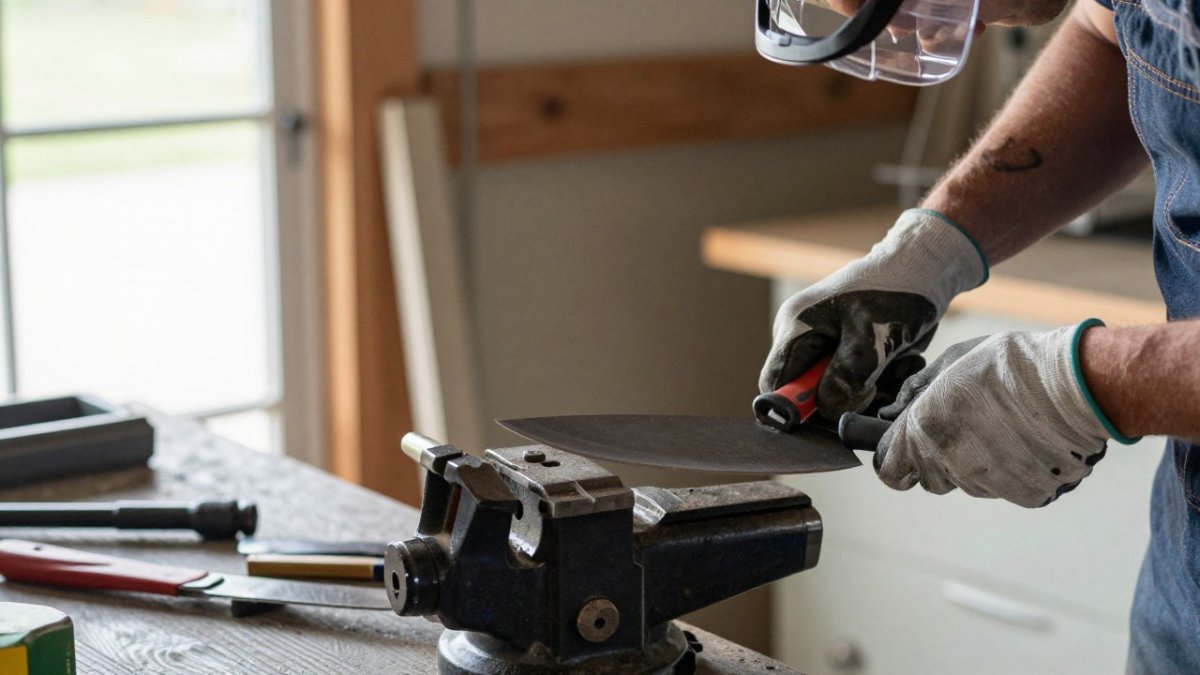
Clamp the blade firmly in a vise with the cutting edge facing you. Support the far end so the blade does not flex while you file.
Look closely at the original angle of the bevel before you remove any metal. There is no single correct angle for every blade.
Identify the cutting edge and the trailing edge. The cutting edge is the sharpened side that leads into the grass; the trailing edge is the blunt back.
Filing and Grinding at the Correct Angle
- Push the flat file in one direction, away from the edge, at the bevel angle. A file cuts on the push stroke, so lift it on the return.
- Keep the stroke steady and follow the bevel. Short, controlled strokes beat long, fast ones.
- Work both ends of the blade equally so the blade stays balanced and cuts evenly.
- For a drill attachment or angle grinder, use light passes and keep the tool moving. Never hold the grinder in one spot long enough to blue the metal; overheated steel loses temper and the edge dulls fast.
- Stop when you feel a slight burr curl over the back of the edge. That thin burr tells you the edge is sharp.
Watch out: over-grinding one end or sharpening past the bevel creates an uneven, weak edge that throws the blade out of balance and causes the vibration you were trying to avoid.
When both ends are sharpened evenly and the burr is gone, move straight to balancing. A sharp blade that is out of balance will still shake the deck and wear the bearings.
How to Balance a Lawn Mower Blade After Sharpening
An unbalanced blade causes vibration that damages bearings and shakes the deck apart over time. Balancing is not optional.
Use a blade balancer or hang the blade on a nail through its center hole. If one side drops, file a little more off the heavy end.
A balanced blade spins smoothly and cuts evenly. Skip this step and you will feel the shake through the handlebars.
How Often to Sharpen Lawn Mower Blades and When to Replace Them
Check your blade regularly during the growing season and sharpen it whenever it shows signs of dulling.
Watch for these signs of a dull blade:
- Grass tips look frayed or white
- The mower pulls or bogs down
- You need a second pass to get an even cut
- Vibration builds up during use
Replace the blade when you find deep nicks, cracks, or a badly bent edge. A blade worn thin near the center is a safety risk, not a sharpening job. For the right cutting height to pair with a sharp edge, see our guide to proper lawn mowing heights.
Mulching, Standard, and High-Lift Blade Differences
Blade type changes how your mower handles clippings. Choose the one that fits your lawn and your goals.
| Blade Type | Best For | Cut Style | Trade-Off |
|---|---|---|---|
| Standard | General mowing | Clean discharge | Less lift for tall grass |
| Mulching | Fine clippings as fertilizer | Recirculates clippings | Struggles in wet, tall grass |
| High-lift | Bagging and heavy growth | Strong upward lift | More engine load |
Best for: homeowners who want clippings returned to the soil. Skip if: your grass is often wet or overgrown.
Match the blade to your mowing conditions. The wrong blade makes even a sharp edge feel dull.
Troubleshooting Vibration and Uneven Cuts After Sharpening
If the mower shakes or cuts unevenly after sharpening, the blade is usually the culprit. Check these fixes in order:
- Vibration: rebalance the blade and check for a bent edge
- Uneven cut: confirm both blade ends are sharpened equally
- Ragged tips: you may have sharpened past the bevel or left a burr
- Deck wobble: tighten the blade bolt to spec and inspect the adapter
A common mistake is over-grinding one side. If the cut still looks rough, our step-by-step guide on how to edge a lawn like a professional helps sharpen up the finished look around beds and walkways.
Sharpening your own blade keeps your mower cutting cleanly and your lawn looking its best. But a busy schedule often gets in the way, and a neglected edge undoes the work fast.
Frequently Asked Questions
What is the easiest way to sharpen a lawn mower blade?
For most homeowners, a flat metal file is the easiest and safest method. Remove the blade, clamp it in a vise, and file along the original bevel in one direction, matching the factory angle. A file removes less metal than a grinder, so you are less likely to over-sharpen or change the angle. If the blade has deep nicks, start with a grinder or drill attachment to rough out the damage, then finish with a file for a clean edge.
What tools do I need to sharpen a lawn mower blade at home?
You need a socket or ratchet wrench that fits the blade bolt, a block of wood to stop the blade from spinning, a bench vise or sturdy clamp, safety gloves, and protective eyewear. For the sharpening itself, a 10-inch mill bastard flat file or an angle grinder with a grinding wheel works well. A blade balancer is worth having so you can check the blade after sharpening. A wire brush helps clean grass buildup before you start.
How often should I sharpen my lawn mower blades?
Sharpen the blade every 20 to 25 hours of mowing, which works out to roughly once a month during the growing season for a typical suburban lawn. Sharpen sooner if you hit a rock, stump, or sandy patch. Signs of a dull blade include ragged grass tips, a yellowed lawn a day after mowing, and the mower straining in tall grass. A sharp blade cuts cleanly and puts less load on the engine.
How do I balance a lawn mower blade after sharpening?
Slide the blade onto a cone-style blade balancer or hang it on a nail through its center hole. A balanced blade sits level. If one side dips, file a little more metal off the heavy side and recheck. Repeat until it hangs even. An unbalanced blade causes vibration that can damage the spindle bearings and leave an uneven cut. If the blade will not balance after several tries, replace it.