 How-to
Lawn Maintenance for Odd Shaped Yards: A Complete Guide
Table of Contents
- Assess Your Yard's Shape, Size, and Obstacles
- How to Mow an Irregular-Shaped Lawn Efficiently
- Best Mowing Pattern for an Odd-Shaped Yard
- Lawn Edging Around Curves and Obstacles
- How Often Should Lawn Be Mowed
- Equipment Selection and Maneuverability
- Safety on Slopes and Handling Narrow Areas
- Frequently Asked Questions
Last Updated: October 18, 2026
Assess Your Yard's Shape, Size, and Obstacles
Before you mow, understand your layout, odd shaped yards with curves, slopes, trees, and beds all affect your route.
Measure and map your layout
Measure your yard with a tape measure or app and note the total square footage, this guides equipment choice.
Sketch a map or take overhead photos, marking trees, beds, patios, pathways, slopes, and poorly draining areas.
Note how the yard connects to your home, driveway, and street, this affects where you start and how you move equipment.
Identify fixed obstacles and problem areas
Walk your yard and list every obstacle: trees and shrubs, garden beds, pathways, patios, fences and gates, low branches or power lines, wet spots, and steep slopes.
Note problem areas, thin grass near trees, wet sections, and adjust mowing height or frequency there.
How to Mow an Irregular-Shaped Lawn Efficiently
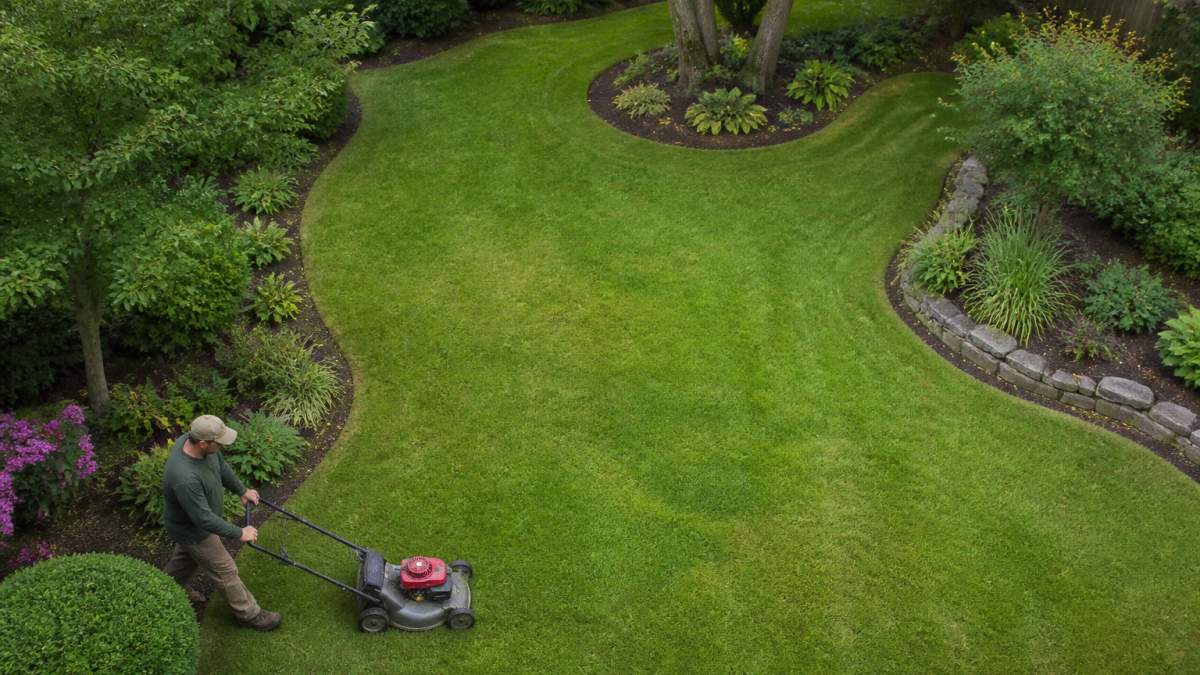
Mowing an odd-shaped yard efficiently comes down to one habit: plan the route before you pull the starter cord. Here's a shape-by-shape playbook.
The routing principles behind every odd-shape plan
Every efficient route on an irregular lawn follows the same four rules:
- Perimeter first. Make one full border pass around the outside edge. This establishes a clean boundary and gives you a visual guide for the interior.
- Longest straight runs next. Mow the longest uninterrupted lines before you tackle the tight stuff. You cover the most ground with the fewest turns while you're fresh.
- Obstacles last. Mow around trees, beds, and posts after the open areas are done. You're already slowing down for trimming, so you're not wasting momentum.
- Turn on the inside. When you must turn, turn toward the already-cut side so the mower's uncut side stays clean and you avoid tire marks on tall grass.
Walk the yard once and trace your intended path. If you'd have to back up or make a three-point turn, adjust the route before you start.
L-shaped and T-shaped lawns
L-shaped and T-shaped yards have two or three long legs meeting at a corner. The mistake is mowing each leg separately and leaving a messy junction.
- Mow the longest leg first in straight parallel passes, starting from the outer edge and working toward the inside corner.
- Mow the second leg the same way, but stop your passes about one mower-deck width short of the junction.
- Finish the junction last with a short series of passes that blend the two directions. This is where most people leave a patch of uncut grass or a scalped corner.
If the legs are narrow (under about 6 feet wide), skip the parallel passes and mow each leg in a single perimeter loop, then clean up the center with one straight pass.
Triangular and wedge-shaped lawns
Triangles are the shape most likely to produce missed strips, since parallel passes leave a growing wedge of uncut grass at the point.
- Start at the widest side and mow parallel to it, working toward the point.
- Stop when your remaining strip is narrower than the mower deck. Don't try to squeeze the mower into the point.
- Finish the point with a string trimmer or by mowing a short perimeter loop around the tip.
For a long, narrow triangle, mow parallel to the longest side instead. You'll make fewer turns and the point becomes a quick trim rather than a series of awkward passes.
Narrow strips and side yards
Strips narrower than two mower widths are a route-planning problem, not a mowing problem.
- If the strip is wider than the mower deck but narrower than two decks, mow it in a single pass down the center, then trim both edges.
- If the strip is narrower than the deck, don't force the mower in. Use a string trimmer for the full width, or remove the grass entirely and convert the strip to mulch, gravel, or a planted bed, a common solution for the dead space between a fence and a driveway.
- For long strips, mow in one direction only and blow clippings to one side. Back-and-forth passes on a narrow strip double your turn count for no benefit.
Curved and kidney-shaped borders
Curves reward contour mowing; fighting them with straight passes leaves scalloped edges and missed crescents.
- Make one perimeter pass that follows the curve at a consistent distance from the edge.
- Continue in concentric contour passes, each one a mower-deck width inside the last, spiraling inward.
- Finish the center with whatever short straight passes fit.
This concentric approach is usually faster than a grid on a heavily curved lawn: it eliminates the stop-and-turn at every curve, and the cut lines echo the border instead of cutting across it.
Multi-section lawns with beds, paths, and outbuildings
When beds, paths, sheds, or fences break a yard into disconnected patches, treat each patch as its own mini-lawn and connect them with a planned travel route.
- Number the sections on your sketch in the order you'll mow them, starting with the largest and ending with the smallest.
- Plan the travel path between sections so you cross paved areas rather than mowing through them, and so you're never carrying a full bag uphill or across the whole property.
- Mow the connecting strips last, after the main sections, so any clippings you blow onto them get cleaned up in the final pass.
A practical rule: if a section takes less than two minutes to mow, group it with an adjacent section rather than treating it as a separate stop.
Once you've settled on a route, write it down or photograph your sketch. The same route works week after week, so you stop re-solving the same puzzle every Saturday.
Best Mowing Pattern for an Odd-Shaped Yard
The mowing pattern you choose affects how your lawn looks and how long the job takes.
Perimeter pass and grid patterns for irregular shapes
A perimeter pass means mowing around the outside edge first, creating a clean border and a clear boundary to work within on odd shaped yards. Then mow the interior in straight lines or a grid pattern. The perimeter-plus-grid approach works well for most odd-shaped yards: simple, efficient, and clean-edged.
Striping and contour patterns for curved lawns
Striping creates visible alternating light and dark lines by mowing in one direction, then the opposite direction on your next pass; the difference in grass angle creates the effect. It looks great on formal lawns but requires consistent, parallel passes, so curved or very irregular yards make it hard to achieve. Contour patterns follow the natural shape of your yard, mow along curved garden beds, around tree lines, or along the contour of a slope.
Lawn Edging Around Curves and Obstacles
Clean edges make your lawn look polished, and edging matters especially on odd-shaped yards where curves and obstacles are visible.
Trimming edges around garden beds and trees
After mowing, use a string trimmer around garden beds and trees to remove grass the mower can't reach and create a sharp line between lawn and bed. Walk slowly, holding the trimmer at a slight angle so the line of cut is perpendicular to the ground.
Creating clean transitions at pathways and patios
Pathways and patios need clean edges too. Trim grass growing over the edge to keep the lawn from looking overgrown and the paths safe. For curved pathways, make multiple small trimming passes rather than one long cut for better control and a cleaner result.
How Often Should Lawn Be Mowed
Mowing frequency depends on grass type, season, and growth rate. Most lawns need weekly mowing during the growing season; fast-growing yards may need twice weekly.
Seasonal mowing frequency and grass height
Spring and fall are peak growing seasons: mow weekly, sometimes twice weekly if rainfall is heavy. Summer depends on heat and moisture, hot, dry summers slow growth (mow every 7-10 days), while hot, humid summers speed it (mow weekly or more often). Winter mowing is minimal: in mild climates, mow every 2-3 weeks if grass keeps growing; in cold climates, stop when grass goes dormant.
Adjusting schedule for slopes and narrow areas
Slopes and narrow areas sometimes need different schedules. Dry slopes can be mowed less often; wet slopes need more frequent mowing to prevent compaction and disease.
Narrow, shaded areas grow slower and may need less frequent mowing than sunny spots.
Equipment Selection and Maneuverability
The right equipment makes an odd-shaped yard feel manageable; the wrong equipment turns every corner into a wrestling match. The decision isn't push versus riding, it's matching deck width, turning radius, weight, and gate clearance to your yard's constraints.
Start with the constraints, not the machine type
Before you shop, measure four things:
- Your narrowest gate or passage. This is a hard limit. A mower that won't fit through the gate is useless no matter how well it cuts.
- Your tightest turning space, the distance between a tree and a fence, or the width of a side yard.
- Your steepest slope, in degrees if you can estimate it.
Every equipment choice below is a trade-off against these four numbers.
Deck width: the single biggest maneuverability factor
Deck width determines both how much grass you cut per pass and how tightly you can navigate.
- Under 18 inches: highly maneuverable, good for narrow strips and dense obstacle fields, but requires many more passes on open ground.
- 18-22 inches: the practical sweet spot for most odd-shaped residential yards. Wide enough to be efficient, narrow enough to fit through standard gates and around beds.
- 22-30 inches: efficient on larger open sections, but starts to feel clumsy around curves and tight corners.
A common pattern on odd-shaped properties is a mid-width deck for the main lawn plus a string trimmer for edges and narrow strips, rather than one oversized machine trying to do everything.
Turning radius and zero-turn considerations
Turning radius is the space a mower needs to complete a 180-degree turn.
- Standard push mowers turn in roughly their own length, which is fine for most residential yards.
- Front-wheel-drive and rear-wheel-drive push mowers differ in how they handle slopes and tight turns; rear-wheel drive generally grips better on inclines but can be harder to pivot.
- Zero-turn riding mowers can pivot in place, a real advantage on complex shapes, but they're heavier, more expensive, and can tear turf if you turn too aggressively on wet grass.
For most odd-shaped yards under about a quarter acre, a maneuverable push mower plus a trimmer beats a riding mower on both time and finish quality.
Gate clearance, storage, and transport
These practical constraints get overlooked and then force a return:
- Measure the gate opening, not the gate. Hinges and posts reduce usable width by several inches.
- Check folded dimensions if you store the mower in a shed or garage with limited depth.
- Confirm the mower fits your vehicle or trailer if you transport it between properties.
A mower that fits the yard but not the gate is the most common equipment mistake on irregular properties.
Weight, traction, and slope limits
Heavier mowers grip better on slopes but are harder to control and more likely to damage wet turf.
- On slopes, mow across the face, not up and down, regardless of machine type.
- Avoid mowing slopes when grass is wet, traction drops and ruts form.
- For steep sections, a lighter push mower or a string trimmer is often safer than a heavy riding mower.
A simple selection checklist
Match your measurements to the machine:
- Gate narrower than 30 inches? Prioritize a deck that fits with margin.
- More than a few tight corners or a side yard under 6 feet wide? Favor a narrower deck and a tight turning radius.
- Mostly open lawn with obstacles only at the edges? A wider deck or a riding mower for the center plus a push mower for edges works well.
- Steep slopes? Favor lighter equipment and plan to trim rather than mow the steepest sections.
Test any mower in your own yard before committing if the retailer allows it. Walk it through your tightest passage and around your most awkward obstacle, that five-minute test tells you more than any spec sheet.
Safety on Slopes and Handling Narrow Areas
Mowing safely on slopes and in tight spaces prevents injuries and equipment damage.
Safe mowing techniques on uneven ground
On slopes, mow across the slope, never up and down, mowing up and down increases the risk of tipping, while mowing sideways keeps the mower stable. Wear sturdy shoes with good grip; slopes are slippery, especially when wet or covered with leaves.
Avoiding common mistakes in tight corners and asymmetrical spaces
In tight corners, don't rush. Mow slowly and carefully. Rushing leads to missed spots or hitting obstacles.
Never reach under the mower while it's running.
Keep bystanders, especially children and pets, away from the mowing area. Mowers can throw objects at high speed.
Mowing an odd-shaped yard takes more planning than a standard rectangular lawn, but it's entirely manageable with the right approach. If you'd rather focus on other priorities while your lawn stays perfectly maintained, GET A QUOTE from EarthWise Lawn and Landscape LLC today.
Frequently Asked Questions
How do you mow an odd-shaped lawn without leaving missed strips?
Start by dividing your yard into geometric sections and mowing one section completely before moving to the next. Use a perimeter pass first to establish a clear border, then work toward the center using overlapping passes. Mark your route on paper beforehand. Check your mower's turning radius and adjust your path to avoid sharp corners that could cause missed spots. Most missed strips happen when you rush the transition between sections, so take time at corners and around obstacles.
What's the best mowing pattern for an odd-shaped yard?
The perimeter-to-center approach works best for irregular yards. Start at the outer edges and work inward in a spiral or grid pattern. For curved lawns, follow the natural contours rather than fighting them. Striping patterns work well on rectangular sections but may not suit heavily curved or asymmetrical yards. The key is consistency: mow in the same direction within each section, and alternate your overall pattern week to week to prevent soil compaction and promote even grass growth.
How often should lawn be mowed in different seasons?
During active growing seasons (spring and early fall), most lawns need mowing every 7-10 days. Summer may require weekly mowing depending on rainfall and heat. Maintain grass at 2.5-3.5 inches for most species. Reduce frequency in late fall and winter as growth slows. Odd-shaped yards with multiple obstacles may need more frequent attention around edges and tight spaces to maintain a polished appearance. Never remove more than one-third of the blade in a single mowing to keep grass healthy.
Should I use a push mower or riding mower for an awkward-shaped lawn?
Push mowers excel in yards under 0.5 acres with tight corners, narrow passages, and dense obstacles. They offer superior maneuverability and precision around garden beds and trees. Riding mowers work better for larger irregular yards if you have enough open space for turns. Consider your yard's turning radius: a riding mower needs 6-8 feet to turn safely, while push mowers need only 2-3 feet. For most odd-shaped residential yards, a quality push mower with a sharp blade and proper maintenance delivers better results than a riding mower.