 Listicle
Lawn Care Services for High Value Homes: 2026 Guide
Table of Contents
- What Lawn Care Services for High Value Homes Actually Require
- Professional Lawn Care Services: What Separates Premium Providers
- Lawn Mowing Service Standards That Protect Curb Appeal
- Lawn Fertilization Service and Soil Care for Estate-Scale Turf
- Lawn Weed Control Without Damaging Mature Landscapes
- Service Frequency, Maintenance Plans, and Pricing Factors
- Discretion, Property Security, and Landscape Asset Protection
- Choosing a Provider: Questions to Ask Before You Sign
- Frequently Asked Questions
Last Updated: October 17, 2026
What Lawn Care Services for High Value Homes Actually Require
Lawn care services for high value homes are maintenance programs built around precision, consistency, and protection of the landscape as a financial asset. At EarthWise Lawn and Landscape LLC, we have spent more than 30 years learning that a property is judged in seconds by the state of its turf, edges, and beds. The stakes are higher than they look.
Professional Lawn Care Services: What Separates Premium Providers
Premium providers differ from standard crews in three areas: equipment, technique, and accountability. Professional lawn care services at this level start with commercial-grade mowers, sharpened blades, and operators trained to adjust cutting height by season and grass type. The difference shows up in the details. A sharp blade cuts cleanly; a dull one tears the leaf and opens the turf to stress and disease.
Lawn Mowing Service Standards That Protect Curb Appeal
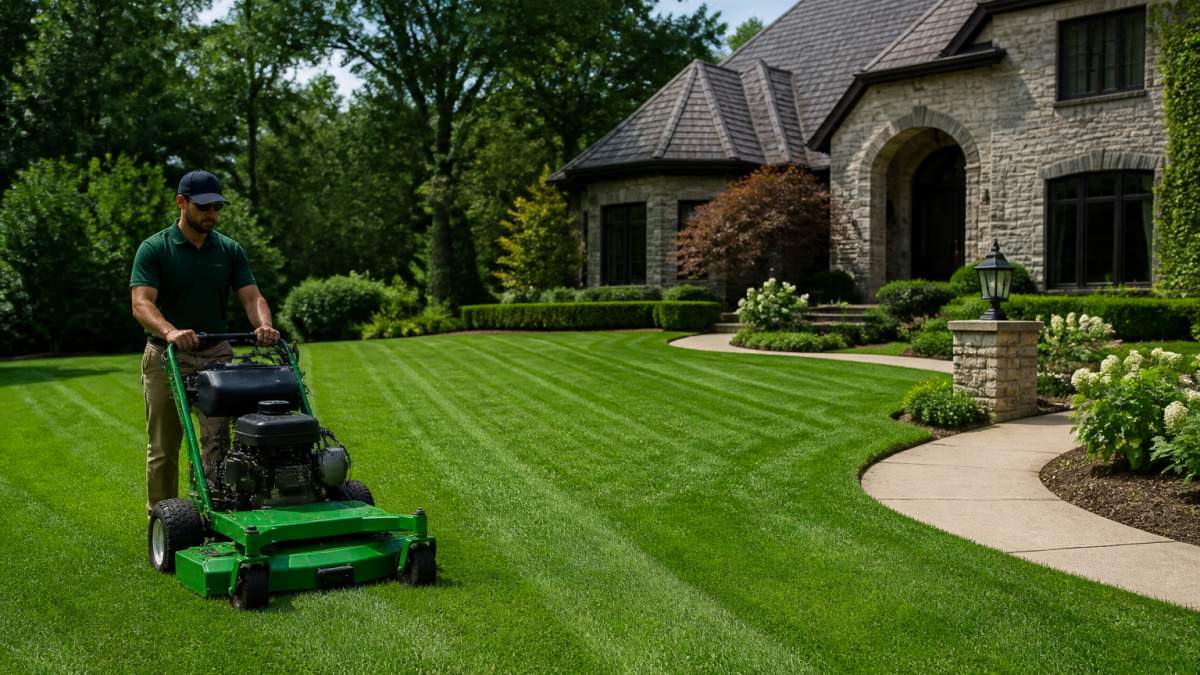
A lawn mowing service that protects curb appeal follows one rule above all: never remove more than one-third of the grass blade in a single cut. That single practice, recommended by turf specialists at university cooperative extension programs, keeps grass healthier and color more even.
Lawn Fertilization Service and Soil Care for Estate-Scale Turf
A lawn fertilization service should begin with a soil test, not a calendar. Soil pH, nutrient levels, and organic matter determine what your turf actually needs, and estate-scale lawns often have varied soil conditions across a single property. The USDA Natural Resources Conservation Service maintains soil survey data that can help identify what you are working with before a single application. Healthy soil is the foundation of every healthy lawn.
Lawn Weed Control Without Damaging Mature Landscapes
Effective lawn weed control targets the weed, not the whole yard. On properties with mature trees, established shrubs, and ornamental beds, blanket herbicide applications can damage roots and stress valuable plantings. A careful provider identifies the weed species first, then chooses spot treatment, pre-emergent timing, and cultural practices like proper mowing height and overseeding to crowd weeds out over time.
Service Frequency, Maintenance Plans, and Pricing Factors
Most premium properties run on a weekly mowing schedule during the growing season, shifting to bimonthly maintenance or as-needed visits in slower months. A maintenance plan should spell out visit frequency, what each visit includes, and how seasonal cleanups fit in. The real differentiator for a high-value home is not the base mowing rate, it is how the plan is structured and what it leaves out.
What actually drives the price
Pricing for estate-scale lawn care is built from a handful of measurable inputs. Ask any provider to break the estimate down against these, line by line:
- Acreage and mowable area. Total lot size is not the same as turf that actually gets cut. Fenced pastures, wooded buffers, and mulched beds reduce mowable square footage but add trimming and edge work. A provider should quote on mowable area, not the deed.
- Terrain and access. Slopes, retaining walls, narrow gates, and detached structures slow a crew and require smaller equipment. Steep grades may need walk-behind or remote-controlled mowers, which carry a higher labor cost per acre.
- Landscape complexity. Specimen trees, formal hedges, perennial beds, and hardscaping all require hand work and careful equipment placement. Complexity raises labor hours faster than it raises acreage.
Basic mowing vs. comprehensive estate maintenance
A basic plan keeps the lawn cut. A comprehensive estate plan manages the landscape as an asset. The table below shows how the two typically compare so you can see what you are actually buying.
| Plan Element | Basic Mowing Plan | Comprehensive Estate Plan |
|---|---|---|
| Mowing and edging | Weekly in season | Weekly in season, with pattern rotation and height adjustment |
| Trimming and blowing | Walk and drive edges | All edges, beds, hardscape, and lighting fixtures cleared |
| Fertilization | Not included or calendar-based | Soil-test-based program, adjusted for weather |
| Weed control | Spot spray as needed | Species-specific spot and pre-emergent treatment with bed and tree protection |
| Irrigation | Not included | Seasonal head checks and scheduling review |
| Cleanups | Optional add-on | Spring and fall, with debris haul-away included |
| Communication | Text when the crew is coming | Advance schedule changes, photo proof of completed work, single point of contact |
How to compare estimates fairly
Two quotes for the same property can differ by hundreds of dollars a month and still both be honest, because they cover different scopes. Before you compare totals, confirm that each estimate states the number of visits per season, whether edging and blowing are included at every visit, whether fertilization and weed control are bundled or separate, and whether cleanup debris is hauled away.
| Plan Element | Typical Frequency | What It Covers | What to Confirm |
|---|---|---|---|
| Mowing and edging | Weekly in season | Cut, trim, edge, blow clean | Height settings, pattern rotation |
| Fertilization | Seasonal program | Soil-based feeding | Soil test included? |
| Weed control | Targeted, as needed | Spot and pre-emergent treatment | Bed and tree protection |
| Yard cleanup | Spring and fall | Leaf removal, bed refresh | Debris haul-away included? |
Discretion, Property Security, and Landscape Asset Protection
High-value homeowners ask about security before they ask about price, and they should. A dependable provider documents arrival and departure, uses consistent crew members, communicates schedule changes in advance, and treats gates, locks, and access codes with care. Landscape asset protection matters too: crews should know which beds are off-limits to equipment, where irrigation heads sit, and how to avoid damaging hardscape, lighting, and fencing.
Choosing a Provider: Questions to Ask Before You Sign
Most provider-selection advice stops at 'are you insured?' That question is a starting point, not a standard. For a high-value property, the difference between a competent crew and a liability is in the details of coverage, training, and accountability. Use the checklist below as a working document, ask every provider the same questions and compare the answers side by side.
Insurance and licensing
- General liability limit. Ask for the certificate of insurance and read the limit, not just the presence of coverage. A policy that covers a small residential lot may not be adequate for estate-scale work near structures, hardscape, and mature trees.
- Workers' compensation. Confirm the crew is covered. If a worker is injured on your property and the provider carries no workers' comp, the exposure can follow the homeowner.
- Proof, not promises. A vetted provider will email a current certificate without hesitation. Hesitation is an answer.
Staff training and crew consistency
- Who actually does the work? Ask whether the same crew services your property each visit and whether that crew is employed or subcontracted. Rotating subcontractors is the most common cause of inconsistent quality on premium properties.
- What training do operators receive? Look for instruction in cutting height by grass type and season, pattern rotation, blade sharpening intervals, and equipment handling near beds and irrigation.
- Supervision. On estate-scale grounds, ask who inspects the finished work and how often. A crew without a supervisor is a crew without a standard.
Equipment and technique
- Commercial-grade mowers and sharp blades. Ask how often blades are sharpened. Dull blades tear turf and open it to disease, a detail that shows up weeks later.
- Right-sized equipment. Large mowers damage wet turf and tight corners. A premium provider matches equipment to terrain and conditions rather than forcing one machine across the property.
- Cleanup standards. Edging, blowing, and hardscape clearing should be described in writing, not left to the crew's judgment.
References and track record
- Ask for references from comparable properties. A provider who services small lots may be excellent at that scale and inexperienced at yours. Request two or three references from properties similar in size and complexity.
- Ask how long the average client stays. Long-tenured clients are the clearest signal of consistent service.
- Ask about turnover. High crew turnover undermines the consistency premium properties depend on.
Communication and written guarantees
- Single point of contact. You should know exactly who to call and how quickly to expect a response.
- Written service agreement. The scope, frequency, and exclusions should be in writing, not summarized verbally.
- Service guarantee. Ask what happens if a visit is missed or the work falls short. A provider with a real guarantee will state the remedy plainly.
The checklist
- Certificate of insurance with adequate general liability limits
- Workers' compensation coverage confirmed
- Same crew each visit, employed not subcontracted
- Documented training in cutting height, pattern rotation, and blade care
Local professionals with a long track record typically welcome these questions; unreliable contractors dodge them. We built our family business on more than 30 years of hands-on work.
Frequently Asked Questions
What lawn care services are best for high value homes?
High value homes need more than basic mowing. Look for a provider that mows at the correct height with sharp blades, varies mowing patterns to prevent ruts, and edges and trims every visit. Add a lawn fertilization service built around soil testing, targeted lawn weed control, and seasonal cleanups. The best programs also include irrigation checks and photo documentation so you can confirm the work was done. Ask for a written service scope before you commit, and confirm the crew is insured and trained on equipment that won't tear up mature landscaping.
How does professional lawn care affect a home's curb appeal?
Curb appeal is the first thing a buyer or guest notices, and turf condition drives most of that impression. Consistent mowing at proper heights, crisp edging, and clean trimming lines make a property look maintained rather than merely cut. A lawn fertilization service and lawn weed control keep color even and reduce bare patches that read as neglect. For high value homes, the difference is in the details: striped patterns, clean bed lines, and no clippings left on walks. Those details signal that the whole property is cared for.
Can a well-maintained lawn increase property value?
A healthy, well-kept lawn supports property value by improving how the home shows and by signaling that the property has been maintained. Appraisers and buyers both respond to consistent exterior care. The gain is not automatic: it depends on the lawn staying healthy year-round, not just before a listing. A maintenance plan with regular mowing, a lawn fertilization service, and lawn weed control keeps turf dense, which crowds out weeds and reduces repair costs later. Treat it as ongoing upkeep rather than a one-time project.
How often should a high-end home's lawn be mowed?
Most cool-season lawns need mowing every 7 to 10 days during active growth, and warm-season grasses may need it every 5 to 7 days in peak season. The rule that matters more than the calendar: never remove more than one-third of the blade height in a single cut. For larger properties and acreage, a lawn mowing service should adjust frequency by season, growth rate, and irrigation. Bimonthly maintenance is common in slower growth periods. Ask your provider to put the schedule in writing so frequency doesn't drift.
What should I look for in a lawn care service for a high-value property?
Start with proof of insurance and a written scope that lists mowing heights, edging, trimming, blowing, and cleanup. Ask whether the same crew services your property each visit, since familiarity with gates, irrigation heads, and bed lines prevents damage. Confirm they sharpen blades regularly, because dull blades tear grass and invite disease. Look for a provider that offers a lawn fertilization service and lawn weed control under one plan, gives photo proof of completed work, and handles billing without cash. Get a service estimate in writing before the first visit.