 How-to
Can You Mow an Irregularly Shaped Lawn Cleanly?
Last Updated: October 28, 2026
Quick Summary
You can mow an irregular lawn cleanly by mowing the perimeter first, then working toward the center in loops that follow the shape, overlapping each pass by a few inches. Turn on already-cut grass, slow down before corners, and vary your turn points each week so you don't carve bare patches.
- Split the yard into rectangles, triangles, and circles, measure each block, then add them together for square footage.
- On kidney-shaped and curved lawns, overlap each inner loop pass by 3 to 4 inches so no strip stands up.
- Mow across the face of slopes rather than straight up and down, and make a three-point turn on tight corners.
- Add one more sprinkler head than the open area seems to need at a tight curve to close the coverage gap.
- Walk the route with the mower off and mark turn points with a flag or stake before changing patterns.
Table of Contents
- Why Irregular Lawn Care Demands a Different Approach
- How to Measure an Irregular Lawn Before You Plan Anything
- How to Mow an Awkward-Shaped Lawn Without Scalping or Missed Strips
- Lawn Mowing Patterns for Curved Lawns and Narrow Sections
- Lawn Edging for Curved Borders and Obstacles
- Irrigation and Watering Coverage on an Uneven Yard
- Seasonal Mowing Heights and Repair for Odd Lawn Shapes
- Get a Quote for a Maintenance Plan Built Around Your Yard
- Frequently Asked Questions
Why Irregular Lawn Care Demands a Different Approach
Lawn care for irregularly shaped lawns is a different job than mowing a simple rectangle. At EarthWise Lawn and Landscape LLC, we bring more than 30 years of hands-on experience to lawn care. An irregular lawn needs a plan, not just a mower, because it has no long straight runs to hide mistakes.
Below, we discuss planning and mowing a yard that refuses to be a simple box.
How Lawn Shape Changes Your Whole Maintenance Plan
Shape sets everything: your mowing route, cutting height, turn points, and where your sprinkler can actually reach. A rectangular lawn lets you mow in long, straight passes, while an irregular shape forces you to think in loops and arcs, and tight corners and shaded curves grow unevenly, changing how often you mow.
Here is what shape affects most:
- Mowing route: perimeter loops replace straight back-and-forth passes
- Turning room: tight corners need a turn plan, or you tear the turf
- Water coverage: odd outlines leave dry pockets a single sprinkler misses
- Mowing height: slopes and shade need a different cut than open sun
- Repair needs: bare spots cluster where mowers turn and where water pools
For small, complex yards, see lawn care for small complex yards.
How to Measure an Irregular Lawn Before You Plan Anything
Measure the lawn in simple blocks, not as one shape. Split the yard into rectangles, triangles, and circles, measure each piece, then add them together.
- Sketch the outline. Draw the yard on paper, including beds, trees, and the house.
- Break it into blocks. Mark every rectangle, triangle, and half-circle you can find.
- Measure each block. Use a tape measure or a long reel tape for the long runs.
- Do the math. Rectangle: length times width. Triangle: half of base times height. Circle: 3.14 times radius squared (Area of Plane Shapes).
- Add the blocks. The total is your square footage.
- Mark obstacles. Note every tree, post, and bed edge on the sketch.
Keep that sketch as a reference. A common mistake is measuring only the open grass and forgetting the strips along fences and beds. See lawn maintenance for odd shaped yards for more information.
Measuring an irregular lawn comes down to breaking it into simple blocks and adding them up.
| Step | What to do |
|---|---|
| Sketch the outline | Draw the yard, including beds, trees, and the house |
| Break it into blocks | Mark every rectangle, triangle, and half-circle |
| Measure each block | Use a tape measure or long reel tape |
| Do the math | Rectangle: length times width; triangle: half base times height; circle: 3.14 times radius squared |
| Add the blocks | The total is your square footage |
| Mark obstacles | Note every tree, post, and bed edge on the sketch |
How to Mow an Awkward-Shaped Lawn Without Scalping or Missed Strips
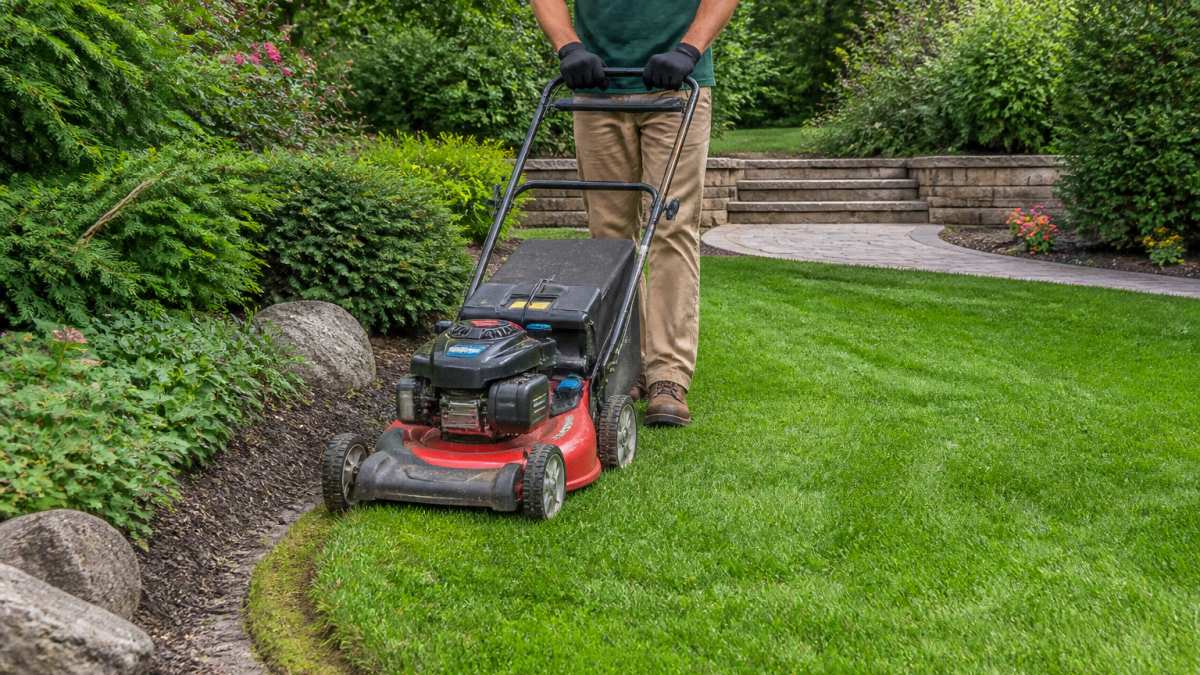
Mow the perimeter first, then work toward the center in loops that follow the shape.
Working the Perimeter First, Then Toward the Center
Start with one full lap around the lawn edge at your normal deck height and a steady pace. Then work inward in loops, overlapping each pass by a few inches and following the curve.
Safe Turning Techniques on Slopes and Tight Corners
Turn on the already-cut grass, not the tall grass, and slow down before the corner, not during it. On slopes, mow across the face rather than straight up and down. On tight corners, make a three-point turn or pull back and reset, sharp zero-turns rip turf, especially when wet. For crews, we set a rule: slow in, slow out, and never spin the wheels on a corner.
Lawn Mowing Patterns for Curved Lawns and Narrow Sections
On an irregular lawn, the mowing pattern has to fit the shape. Below are route plans for four lawn shapes.
L-Shaped Lawns: Two Rectangles, One Route
Treat an L-shaped lawn as two rectangles joined at the corner. Mow the long leg first in straight passes, then the short leg, and finish with a perimeter loop around the whole L.
- Long leg: back-and-forth passes parallel to the longest straight edge
- Short leg: back-and-forth passes perpendicular to the long leg so clippings spread evenly
- Inside corner: slow to a crawl, make a three-point turn on already-cut grass, and never pivot the mower deck on the turf
- Blend pass: one full perimeter loop at the end ties the two legs together visually
Kidney-Shaped and Curved Lawns: Follow the Arc
For kidney shapes and free-form curves, a loop-based route is one option. Start with a perimeter lap that follows the curve, then work inward in shrinking loops.
- Perimeter lap: set the deck to normal height and follow the curve without correcting every wobble
- Inner loops: overlap each pass by 3 to 4 inches so no strip stands up between loops
- Turn points: vary them each week, turning on the same spot carves a bare patch
- Stripes: on a curve, gentle arcs read better than hard stripes; reverse direction on alternating passes to make the arcs show
Narrow Sections and Side Yards: Cut Last, Cut at an Angle
Narrow strips between a fence and a bed can be challenging. One option is to cut them after the open areas.
Pattern Rotation That Works on Any Shape
Here are three possible mowing patterns for curved lawns:
- Curve-following loops: clean look, good for weekly cuts
- Diagonal passes: breaks up ruts and grain
- Perimeter plus center loops: best for tight, narrow sections
Lawn Edging for Curved Borders and Obstacles
A common mistake is cutting the edge too deep. A shallow, consistent line looks better and lasts longer.
Irrigation and Watering Coverage on an Uneven Yard
Place sprinklers by coverage, not convenience. Check placement with a simple test: set small cans across the lawn, run the system, and measure how much water each catches. That test is the foundation of everything below, head placement, overlap, zoning, and dry-spot repair all depend on knowing where the water actually lands.
Head Placement and Overlap for Odd Outlines
A common pattern is to add one more head than the open area seems to need at a tight curve. The extra head closes the gap that a single wide arc leaves behind.
Zoning an Irregular Lawn
If you cannot rezone, run the system in manual cycles and move a portable sprinkler to the thin spots. It is more work, but it beats a dry corner that turns into a bare spot.
The Can Test: Measuring Coverage
Most practitioners find that one or two dry pockets account for most of the uneven growth on an irregular lawn. The can test finds them in an afternoon.
Watering Slopes and Uneven Ground
For a maintenance plan, see getting professional lawn maintenance quotes.
Seasonal Mowing Heights and Repair for Odd Lawn Shapes
A simple seasonal plan:
For more information, see how often should lawn be mowed.
Get a Quote for a Maintenance Plan Built Around Your Yard
An irregular lawn rewards a plan. If you would rather not spend your weekends measuring blocks and mowing, EarthWise Lawn and Landscape LLC offers regular lawn maintenance.
Here is what that includes:
- Proper mowing heights and sharp blades for a clean cut every visit
- Thoughtful, varied mowing patterns that follow your curves and protect corners
- Mulching for a finished look
- Professional equipment suited to tight sections and slopes
If you are ready to hire, see getting professional lawn maintenance quotes and professional lawn mowing service cost expectations.
Frequently Asked Questions
How do you mow an irregularly shaped lawn without leaving missed strips?
Mow the perimeter first, then work inward in bands that follow the shape of the lawn. EarthWise Lawn and Landscape LLC uses sharp blades and proper mowing heights.
What lawn mowing patterns for curved lawns actually look good?
EarthWise Lawn and Landscape LLC uses thoughtful, varied mowing patterns.
How do I measure an irregular lawn for seed or fertilizer?
Break the yard into simple shapes: rectangles, triangles, and circles. Measure each section in feet, calculate its area, then add them together. For a circle, use 3.14 times the radius squared; for a triangle, half the base times the height. Subtract the footprint of beds, patios, and sheds.
How do you edge a curved border cleanly?
Use a half-moon edger or a string trimmer held vertically, and cut in short arcs rather than one long sweep. Work in the same direction along the whole curve so the trench depth stays even. Refresh the edge every few weeks during the growing season, and remove clippings so they do not smother the grass at the border. On beds with mulch, keep the edge trench about 2 to 3 inches deep so mulch stays put after rain and the curve holds its shape.
Your yard's shape is not a problem to work around. It is the plan itself. EarthWise Lawn and Landscape LLC brings more than 30 years of hands-on experience, professional equipment, and consistent service to every property, so your lawn looks clean and well-maintained without you lifting a mower. Get started with EarthWise Lawn and Landscape LLC and get a maintenance plan built around your yard's real shape.