 How-to
How to Secure Lawn Care Service Access to Your Property
Last Updated: November 1, 2026
Quick Summary
Set up lawn care access with a written access sheet that lists your entry point, gate code or lockbox location, water spigot, hazards to avoid, pets, and emergency contacts. Use a temporary, single-purpose credential you can revoke, and never reuse a home security code for lawn access.
- Walk the property with the crew lead before the first visit to point out the gate, spigot, and breaker.
- A gate code you change after each season beats a permanent key.
- Ask who receives the code, how it is stored, and how access is removed when a crew member leaves.
- Pets stay inside or in a fenced area the crew cannot enter during service.
- Photograph any damage the same day and report it to the company in writing.
Table of Contents
- Why Lawn Care Access Needs a Written Plan
- Preparing for Lawn Service: A Checklist Before the First Visit
- Lawn Care Gate Code and Lockbox Options That Protect Your Home
- Lawn Care Service Access Instructions: What to Tell Your Crew
- Lawn Care Service Pet Safety and Protecting Kids and Restricted Areas
- Scheduling and Access Coordination When You Are Away
- Insurance, Liability, and What to Do After an Incident
- Get a Quote and Set Up Your Access Plan with EarthWise
- Frequently Asked Questions
Why Lawn Care Access Needs a Written Plan
A lawn care access plan is a written set of instructions that tells your provider exactly how to enter, work on, and secure your property on every visit. It removes guesswork for the crew and gives you a record of what was agreed. At EarthWise Lawn and Landscape LLC, we have more than 30 years of hands-on experience, and the smoothest visits are the ones with clear access rules.
Here is the uncomfortable truth most guides skip: the risk in lawn care access is not the mowing. It is the open gate, the shared code, and the unlocked side door.
A crew arrives when you are at work. They need a gate opened, a dog contained, and a water spigot found. If none of that is written down, someone improvises. Improvised access is how gates get left open and pets get out.
Below, we break down how to set up lawn care access that protects your home, your family, and your provider.
Preparing for Lawn Service: A Checklist Before the First Visit
Use this checklist before your first service visit so nothing gets missed on day one:
- Walk the property with the crew lead and point out the gate, spigot, and breaker
- Write down your address, gate location, and any tricky entry points
- Confirm the service day and the arrival window in writing
- Secure pets indoors or in a fenced area away from the work zone
- Move cars, bikes, and toys off the grass
- Mark sprinkler heads, lighting, and invisible fence lines
- Share one emergency phone number and a backup contact
- Ask for a certificate of insurance before the first cut
New homeowners underestimate how much a first visit depends on preparation. New homeowners preparing for a first visit can find a broader onboarding checklist. A short walkthrough saves weeks of small problems.
Skipping the walkthrough is a common mistake. A crew that has never seen your yard will have to guess where the property line ends and your neighbor's begins.
Lawn Care Gate Code and Lockbox Options That Protect Your Home
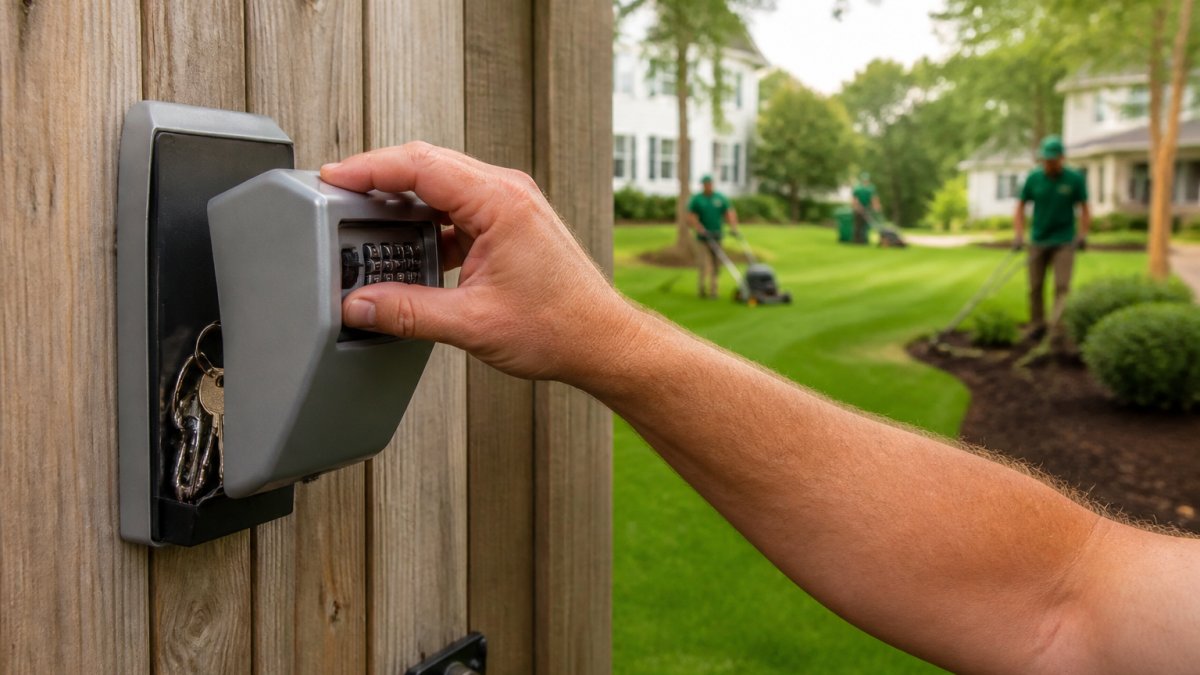
The safest way to give a lawn crew access is a temporary, single-purpose method you can revoke at any time. A gate code you change after each season beats a permanent key. But handling matters more than the method: a code shared widely is weaker than a basic keypad with a code only the crew lead knows.
Here is how the main options compare:
| Access Method | Security Level | Best For | Watch Out For |
|---|---|---|---|
| Keypad gate code | Medium | Fenced backyards | Shared codes that never change |
| Wall-mounted lockbox | Medium-High | Homes with no keypad | Cheap boxes that can be pried open |
| Smart lock with app access | High | Tech-comfortable owners | Dead batteries and Wi-Fi outages |
| Hidden key | Low | Short-term only | Anyone who finds it has full access |
| In-person entry | Highest | Owners who work from home | Slower visits, higher cost |
Protect the credential, not just the gate
A gate code is only as secure as the list of people who have it. Most access problems trace back to a code shared too widely and never rotated. Treat every code, key, and lockbox combination as a credential with a lifecycle: issue, log, rotate, revoke.
Match the method to the property
A keypad gate code works well for a fenced backyard with a single entry point. A wall-mounted lockbox suits homes with no keypad where you want a physical key that can be re-keyed. A smart lock with app access gives the strongest audit trail, most models log each unlock with a timestamp, but depends on batteries and Wi-Fi, so keep a mechanical backup. A hidden key is the easiest way to lose control of access. In-person entry is the most secure and slowest option, which is why it usually costs more.
What to ask before you hand over a code
Ask the provider three questions in writing: Who on your team will receive the code? How do you store it, and who can look it up? What is your process for removing access when a crew member leaves? A company that cannot answer these has not thought about access security.
Lawn Care Service Access Instructions: What to Tell Your Crew
Clear lawn care service access instructions should answer five questions in writing: where to enter, what to avoid, where water is, how to secure the property on exit, and who to call if something goes wrong. The template below covers those five plus the coordination details that keep a visit from becoming an access failure.
Write it once, save it, and send it to every new crew lead. Here is a template you can copy:
Property Access Sheet Address: ____________ Entry point: ____________ (gate on ___ side of house) Gate code or lockbox location: ____________ Water spigot: ____________ Sprinkler heads / lighting / fence lines to avoid: ____________ Pets: ___ (name, location during service) Areas off-limits: ____________ Emergency contact: ____________ Backup contact: ____________ Exit rule: close and latch all gates, lock the side door, return the key to the lockbox
Send this sheet by text or email so there is a written record. A phone call works for a one-time visit, but a written sheet protects both sides over a full season.
Add the coordination details that prevent access failures
The template above is the minimum. Most access problems happen in the gaps around it, an arrival window never confirmed, a gate locked from the inside, a change nobody communicated. Add these fields and rules to close those gaps:
- Change communication. If the service day moves, the code changes, or a pet is added to the household, tell the provider in writing and ask for confirmation. A change that lives only in a phone call gets missed.
When you are away
If you travel, the access sheet does more work, not less. Readers planning access while away can find practical scheduling options for coordinating lawn visits. Confirm service dates in writing before you leave, test the gate code or lockbox yourself, and name a backup contact who is not on a plane. The crew needs someone to call if a gate is stuck or a sprinkler is broken, and that call should not go to voicemail.
A good provider will read the sheet before the first visit and keep it on file.
Lawn Care Service Pet Safety and Protecting Kids and Restricted Areas
Lawn care service pet safety starts with one rule: pets stay inside or in a fenced area the crew cannot enter. Mowers are loud, and a scared dog may bolt through an open gate.
A few habits that prevent most problems:
- Confirm the service window the day before so you can secure pets
- Keep a note on file if a pet is anxious or protective
- Put away toys, balls, and bones before the crew arrives
- Keep kids and their play equipment off the work zone during service
- Mark any restricted area, such as a garden bed or septic field, with a small flag
Children and pets are the two biggest reasons homeowners hesitate to hand over access, and that is fair. The fix is not to skip service. It is to write the boundaries down and confirm them out loud at the walkthrough.
Scheduling and Access Coordination When You Are Away
For longer trips, do three things before you go:
- Confirm the service dates in writing
- Test the gate code or lockbox yourself
- Tell the provider who to contact and what to do if access fails
Insurance, Liability, and What to Do After an Incident
Ask any lawn provider for a certificate of insurance before the first visit.
Lawn crews work around windows, siding, sprinkler systems, and parked cars. Damage happens. What matters is how the company handles it.
Follow these steps after an incident:
- Photograph the damage the same day
- Note the date, time, and which crew was on site
- Report it in writing to the company, not just by phone
- Keep the estimate or repair receipt
- Confirm the claim in writing once it is resolved
A written access plan helps here too. Readers worried about incidents can understand the satisfaction guarantee and recourse. If the crew was told to avoid a sprinkler zone and did anyway, the record shows it. If the damage came from something you never flagged, that is a fair conversation.
Choosing a company carefully helps prevent problems like these. Readers concerned about liability can learn how to vet and choose a reputable company.
Get a Quote and Set Up Your Access Plan with EarthWise
The best access plan is the one you set up before the first mow, not after the first problem.
Our crews mow at proper heights with sharp blades, vary mowing patterns to keep turf healthy, and handle trimming, mulching, and minor cleanups with professional equipment.
Ready to set it up? Get a quote from EarthWise Lawn and Landscape LLC and hand off the mowing with a written access plan that protects your home. Readers ready to hire can find guidance on getting quotes and setting up service.
Frequently Asked Questions
Should I give my lawn care company a gate code?
Yes, if your backyard is fenced and the crew needs access. Use a temporary or unique code rather than your main home security code, and share it only through a written access plan. Change the code when service ends or if the crew changes. A lockbox with a physical key is another option. A clear lawn care access plan protects both you and the crew.
How can I keep my pets safe during lawn service?
Bring pets indoors or into a secure area before the crew arrives. Lawn care service pet safety starts with keeping animals away from mowers, trimmers, and treated areas. If your pet is anxious, close interior doors and leave a note on the access instructions. Pick up pet waste and toys before the visit to avoid accidents and equipment damage.
What should I move before lawn care workers arrive?
Move hoses, sprinklers, toys, garden tools, and lightweight furniture off the lawn. Clear the path to gates and lockboxes. If you have a preparing for lawn service checklist, include these items: unlock gates, secure pets, remove obstacles, and leave out any special instructions. A clear yard reduces the risk of damage and lets crews work more efficiently.
How do I secure outdoor items before lawn mowing?
Lock away valuables like grills, bikes, and tools, and close garage doors. Lawn care access should not mean open access to your home. Use a lockbox for the gate key and keep the house locked. If you are away, ask a neighbor to check that gates are closed after service. A quick walkthrough before the first visit helps confirm what stays locked.