 How-to
7 Proper Lawn Mowing Heights That Keep Grass Healthy
Last Updated: October 30, 2026
Quick Summary
The proper lawn mowing height depends on your grass species, not personal taste. Set cool-season grasses like tall fescue at 3 to 4 inches and warm-season grasses like bermudagrass at 1 to 1½ inches, and never cut more than one-third of the leaf blade in a single pass.
- Taller grass builds deeper roots that reach moisture short turf never touches, helping the lawn hold up in heat.
- Warm-season turf tolerates a shorter cut, while cool-season turf needs more leaf surface to survive summer stress.
- Raise the deck about half an inch when summer heat sets in, then drop back to your standard height in fall.
- Measure from the ground to the blade tip, not to the deck housing, and confirm both sides match.
- Brown tips usually mean dull blades or too much removed in one pass, so sharpen the blade and follow the one-third rule.
Table of Contents
- Why Lawn Mowing Height Decides How Healthy Your Grass Gets
- Lawn Mowing Height Chart: What to Set for Your Grass Type
- The One-Third Rule for Mowing: The Limit You Should Never Break
- Lawn Mower Blade Height Adjustment: How to Measure and Set It Right
- Mowing Height in Summer: When to Raise the Deck and When to Hold
- Adjusting Height for Shade, Slopes, and High-Traffic Areas
- Mowing Height Troubleshooting: Brown Tips, Scalping, and Thin Patches
- Get a Quote for Mowing at the Right Height, Every Visit
- Frequently Asked Questions
Why Lawn Mowing Height Decides How Healthy Your Grass Gets
Lawn mowing height is the single setting most homeowners never touch, yet it decides how thick your turf looks and how well it survives a dry spell. At EarthWise Lawn and Landscape LLC, we have more than 30 years of hands-on experience, and the right deck setting matters a great deal for grass health. For the broader picture of lawn health, see our healthy lawn grass guide.
How Cutting Height Changes Roots, Weeds, and Water Use
Taller grass builds a deeper root system. Deeper roots reach moisture that short turf never touches, so the lawn holds up in heat. Taller blades also shade the soil, which slows water loss and blocks weed seeds from sprouting. There is a trade-off, though. Grass left too long flops over, mats down, and invites disease. The goal is balance, not maximum length.
Lawn Mowing Height Chart: What to Set for Your Grass Type
The right lawn mowing height depends on your grass species, not your personal taste. Here is a general reference chart for setting a mower deck.
| Grass Type | Season | Target Height |
|---|---|---|
| Tall fescue | Cool | 3 to 4 inches |
| Kentucky bluegrass | Cool | 2½ to 3½ inches |
| Perennial ryegrass | Cool | 2½ to 3 inches |
| Fine fescue | Cool | 2½ to 3 inches |
| Bermudagrass | Warm | 1 to 1½ inches |
| Zoysiagrass | Warm | 1½ to 2½ inches |
| St. Augustinegrass | Warm | 3 to 4 inches |
| Centipedegrass | Warm | 1½ to 2 inches |
| Buffalograss | Warm | 2 to 3 inches |
Cool-Season Versus Warm-Season Grasses
Cool-season grasses grow fastest in spring and fall. They handle cooler nights and stay green deeper into the year. Warm-season grasses wake up late, thrive in heat, and go dormant after the first frost. The rule of thumb: warm-season turf tolerates a shorter cut, while cool-season turf needs more leaf surface to survive summer stress. Mixing the two settings is one of the most common mistakes we see.
Identifying a Grass Type You Do Not Recognize
Not sure what you have? Pull one blade and look at three things:
- Blade width: narrow blades usually mean fine fescue or bermudagrass
- Growth habit: runners that creep sideways point to warm-season varieties
- Blade tip: boat-shaped tips signal St. Augustinegrass
Still stuck? New homeowners can start with the basics before setting a height.
A Practical Identification Flow for Unknown Grass
When the three quick checks above do not settle it, walk through this sequence. It turns a vague guess into a confident height setting.
- Look at how the grass spreads. Dig up a small plug at the edge of the lawn. If you see thick underground stems (rhizomes) or above-ground runners (stolons), you have a spreading grass. Bermudagrass, zoysiagrass, and St. Augustinegrass all spread this way. If the plug comes up as a tight clump with no runners, you likely have a bunch-type grass such as tall fescue or perennial ryegrass.
- Check the blade tip and collar. Roll a single blade between your fingers. A blunt, boat-shaped tip is the classic St. Augustinegrass signature. A sharply pointed tip with a visible white collar where the blade meets the stem points toward Kentucky bluegrass or perennial ryegrass. Fine fescue blades are needle-thin and often fold lengthwise.
- Note the color and texture. Fine fescue tends to be the darkest green and the finest textured. Bermudagrass is lighter green and coarser. Zoysiagrass sits in between and feels stiff underfoot.
- Match the region and season. Cool-season grasses dominate northern lawns and stay green into late fall. Warm-season grasses dominate southern lawns and turn tan after the first frost. If your lawn is green in January, you almost certainly have a cool-season grass.
Once you have a species name, return to the chart above and set the deck to the middle of the range. The middle gives you room to adjust up or down as the season changes without resetting the mower from scratch.
Regional Examples That Narrow the Choice
Most lawns are a mix, but one species usually dominates. In the northern half of the country, tall fescue and Kentucky bluegrass are the most common cool-season choices, with fine fescue showing up in shaded or low-input yards. In the transition zone, tall fescue is often overseeded into thinning warm-season turf. In the South, St. Augustinegrass, bermudagrass, zoysiagrass, and centipedegrass cover most residential lawns, with buffalograss appearing in drier western areas.
The One-Third Rule for Mowing: The Limit You Should Never Break
Never cut more than one-third of the leaf blade in a single pass. That is the one-third rule, and it matters more than any other mowing habit. Remove more than a third and the grass goes into shock, yellowing and thinning while it scrambles to rebuild. If you want a clear schedule for that, our guide on how often a lawn should be mowed walks through the timing.
Lawn Mower Blade Height Adjustment: How to Measure and Set It Right
Measure from the ground to the blade tip, not to the deck housing. That single distinction trips up most homeowners, because deck height markings rarely match the true cut.
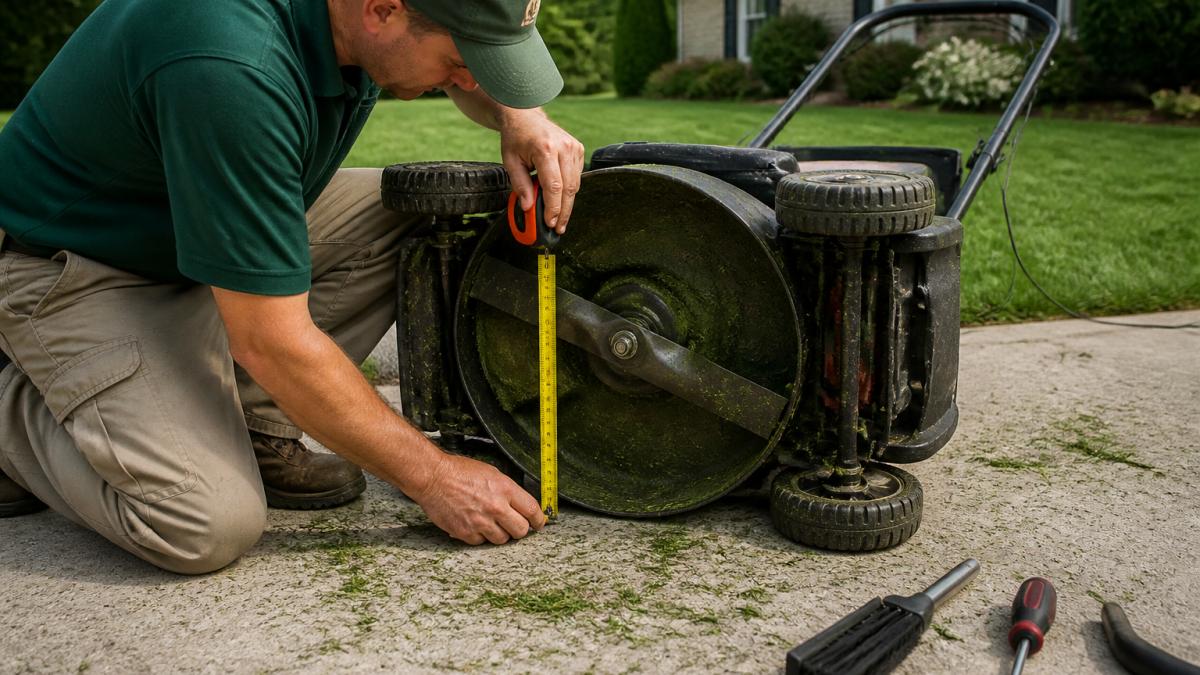
Follow these steps:
- Set the deck to your target height using the mower's adjustment lever
- Measure ground to blade tip on the left and right side
- Adjust until both sides match
- Check tire pressure, since low tires change the cut
- Sharpen or replace dull blades before mowing
Dull blades tear grass instead of slicing it. Torn tips brown off and open the door to disease.
Mowing Height in Summer: When to Raise the Deck and When to Hold
Raise the deck about half an inch when summer heat sets in. Extra leaf surface shades the soil, cuts water loss, and keeps roots cooler. Warm-season grasses can hold their normal setting through heat, but cool-season lawns benefit from the lift. The supporting data behind these seasonal shifts appears in university turfgrass extension guidance, which tracks how cutting height affects stress tolerance.
The Mechanism Behind the Summer Lift
Taller grass does three things at once in heat. First, more leaf area means more photosynthesis, so the plant keeps feeding its roots instead of draining stored energy. Second, the canopy shades the soil surface, which lowers soil temperature and slows evaporation. Third, deeper roots follow from that extra energy, and deeper roots reach moisture that short turf cannot. The trade-off is real: grass left too tall in humid heat can mat and trap moisture, which invites disease.
When to Raise and When to Hold
Use these triggers rather than a fixed calendar date:
- Raise the deck when daytime highs consistently stay above 85°F and the lawn starts to look stressed in the afternoon.
- Raise the deck during a dry spell, even if temperatures are moderate, because taller turf holds moisture better.
- Hold the setting for warm-season grasses such as bermudagrass and zoysiagrass, which are built for heat and can keep their normal cut.
Summer Height by Grass Type
Cool-season lawns generally benefit from the half-inch lift. Tall fescue can go to the top of its range, around 4 inches, while Kentucky bluegrass and perennial ryegrass do well near 3 to 3½ inches. Fine fescue is the exception: it tolerates shade and drought but dislikes heavy summer heat, so keep it in the middle of its range and avoid cutting it short.
Pairing the Lift with Watering and Sharp Blades
Height alone will not carry a lawn through summer. Water deeply and less often so roots grow down rather than staying near the surface. Mow with a sharp blade, because a dull blade tears the taller grass and opens wounds that dry out faster. And keep the clippings on the lawn when you follow the one-third rule, since they return moisture and nutrients to the soil.
Adjusting Height for Shade, Slopes, and High-Traffic Areas
Shade, slopes, and foot traffic all call for a taller cut. Shaded grass grows thinner and weaker, so it needs more leaf area to capture limited light. Slopes dry out faster, and taller turf holds moisture better. High-traffic zones get compacted, and longer blades cushion the crown from wear. Bump up a half inch in each of these spots and watch the recovery.
Mowing Height Troubleshooting: Brown Tips, Scalping, and Thin Patches
Brown tips usually mean dull blades or too much removed in one pass. Scalping, where you see stems and soil, happens when the deck dips on uneven ground or the setting is too low.
| Problem | Likely Cause | Fix |
|---|---|---|
| Brown tips | Dull blade, heavy cut | Sharpen blade, follow one-third rule |
| Scalping | Deck too low, uneven ground | Raise deck, level the surface |
| Thin patches | Repeated short mowing | Raise height, mow more often |
| Yellowing | Shock from overcutting | Cut in stages over several days |
The turfgrass science resources from the university extension system confirm that mowing above the stress threshold protects root growth. For a deeper look at mower setup, equipment guidance from turf specialists covers blade care and deck calibration.
Get a Quote for Mowing at the Right Height, Every Visit
Getting the height right on every visit is the hard part, since growth rates shift week to week. EarthWise Lawn and Landscape LLC provides consistent maintenance with proper mowing heights, sharp blades, varied mowing patterns, and professional equipment for a polished appearance. Readers ready to book can check our professional lawn mowing service cost guide for local pricing expectations. If you are comparing providers, our guide to getting professional lawn maintenance quotes explains what to ask.
Frequently Asked Questions
Is 3 inches a good mowing height?
For most cool-season grasses, yes. Tall fescue and Kentucky bluegrass do well at 3 to 3.5 inches, and many warm-season grasses sit comfortably at 2 to 3 inches. Three inches shades the soil, which slows weed germination and helps the lawn hold moisture through dry spells. The exception is a grass type with a low recommended range, such as bermudagrass on a sports field. Check your grass variety against a lawn mowing height chart before locking in a single setting for the season.
What is the one-third rule for mowing?
The one-third rule for mowing means you never cut more than one-third of the leaf blade in a single pass. If your grass is 4.5 inches tall and your target height is 3 inches, you are removing 1.5 inches, which is exactly one-third. Cut more than that and the plant loses too much of its food-producing surface, so it stalls, yellows, and thins out. If rain pushes growth past the limit, mow sooner rather than lower, and consider a second pass a few days later.
Should I raise my mowing height during hot or dry weather?
Yes. Raising the deck by half an inch in summer gives the lawn more leaf area to shade the soil and more root mass to reach deeper moisture. Taller grass also keeps soil temperatures lower, which reduces stress on the crown. Keep the one-third rule in place while you raise the height, and drop back down gradually in fall so the lawn does not go into winter too long and matted. Sharp blades matter more in summer, since a dull blade tears grass and speeds moisture loss.
How do I find the right mowing height for my grass type?
Start by identifying the grass. Look at leaf width, blade tip shape, and how the plant spreads, then compare it to a lawn mowing height chart for your region. Cool-season grasses such as tall fescue and bluegrass generally want 2.5 to 4 inches, while warm-season grasses such as bermudagrass and zoysia usually want 1.5 to 3 inches. When in doubt, set the mower at the higher end of the range for a month and watch how the lawn responds before lowering it.
Your lawn does not need more products. It needs the right cut, repeated consistently. EarthWise Lawn and Landscape LLC brings more than 30 years of hands-on experience, sharp blades, and proper mowing heights to every visit, so your property stays clean, healthy, and well-maintained without the weekend work. Get started with EarthWise Lawn and Landscape LLC and get a quote for a lawn that looks sharp all season.