 How-to
How to Edge a Lawn Like a Professional, Step by Step
Last Updated: November 5, 2026
Quick Summary
Professional lawn edging means trimming grass where it meets sidewalks, driveways, and garden beds, using a clean, consistent cut depth. Most pros mow first, then edge, then clear debris from the hard surfaces. A string trimmer, manual edger, or rotary edger can produce the finish, depending on border length and type.
- Mow first, then edge, then blow debris off hard surfaces so the border stays clean.
- A string trimmer thicker line of about 0.095 to 0.105 inch holds up better against soil and hard surfaces.
- Hold the trimmer parallel to the ground and cut only a shallow groove into the soil.
- Keep the guard in place and wear eye, hearing, and leg protection before starting.
- Trim overgrown lawns in stages, with a higher-set first pass before the final edge.
Table of Contents
- What Professional Lawn Edging Actually Involves
- Choosing the Right Edging Tool for the Job
- How to Edge a Lawn with a String Trimmer
- How to Edge a Lawn by Hand
- How to Edge an Overgrown Lawn
- Lawn Edging and Mowing Guide: Sequence, Timing and Grass-Type Adjustments
- Scheduling Your Edging Work with EarthWise Lawn and Landscape LLC
- Frequently Asked Questions
What Professional Lawn Edging Actually Involves
Lawn edging is the process of trimming the grass where it meets sidewalks, driveways, garden beds and other borders. Done well, it gives a yard a crisp, finished look that makes the whole property appear cared for.
Professional edging is less about speed and more about consistency. A pro sets a clean line, follows it evenly and cleans up the debris afterward.
A good edge has three traits:
- A straight or intentional curve that follows the border shape
- A consistent cut depth that removes overgrowth without scalping the turf
- A clean boundary with no grass hanging over the hard surface
Choosing the Right Edging Tool for the Job
The right tool depends on the size of the yard, the length of the borders and how much time you want to spend.
| Tool | Best For | Effort Level | Typical Finish |
|---|---|---|---|
| Manual edger | Small borders, tight corners | High | Precise, controlled |
| Rotary edger | Long sidewalks and driveways | Medium | Clean, fast |
| String trimmer | Mixed borders, uneven edges | Medium | Good with practice |
| Wheeled trimmer | Large, flat lawns | Low | Consistent along straight lines |
A string trimmer is the most common choice for homeowners because it handles most jobs. A manual edger works best for small beds and hand-finished corners.
Match the tool to the job, not the other way around.
String Trimmer Setup That Produces a Clean Edge
Most ragged edges traced back to trimmer setup, not operator skill. Before the first cut of the season, check these items:
- Line diameter and type. A thicker line (around 0.095 to 0.105 inch) holds up better against soil and hard surfaces than thin line, but it also draws more power.
- Line length. Cut line to the length the head is designed for. Too much line widens the cut and strains the motor; too little shortens reach and forces you to tilt the head, which is where scalping starts.
- Head angle and guard. Keep the guard in place. It controls how much line contacts the grass and deflects debris away from your legs.
- Blade or head condition. A dull manual edger blade tears grass instead of slicing it, leaving a brown, frayed edge. Sharpen or replace the blade at the start of the season and whenever the cut looks torn.
Watch out: loading line that is too thick for the head can cause the clutch to slip or the line to weld together inside the spool, which turns a five-minute job into a disassembly project.
Matching the Tool to Border Type
Border material changes the best choice more than yard size does. Along concrete sidewalks and driveways, a rotary or wheeled edger keeps a consistent depth because the wheel rides the hard surface.
A common pattern is that homeowners buy one tool and force it to do everything. A better approach is to keep a string trimmer for curves and tight spots and add a manual edger for the short, high-visibility borders near the entry, where precision matters most.
How to Edge a Lawn with a String Trimmer
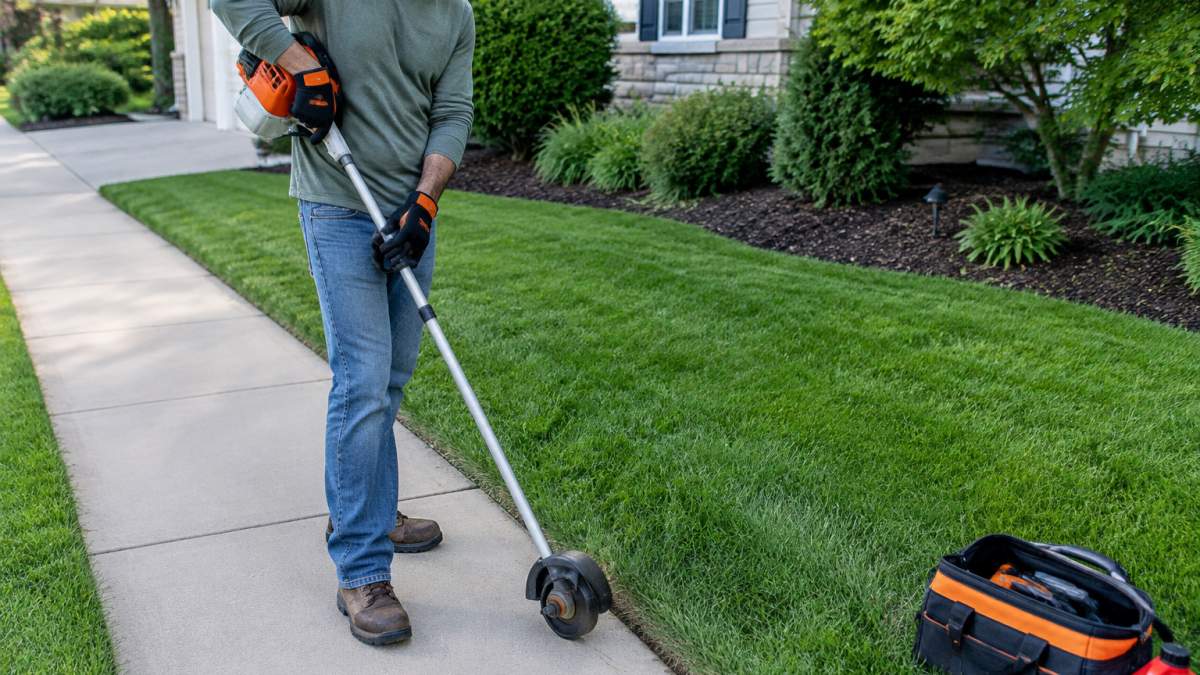
A string trimmer is the tool most homeowners use, and it can give a professional result with the right method. The technique below covers setup, body position, depth control and the fixes for the problems that show up most often.
Safety and Protective Equipment Before You Start
Edging throws debris at high speed. Before the trimmer starts:
- Eye and hearing protection. Safety glasses or a face shield stop grit and clippings; hearing protection matters on gas units and high-powered battery models.
- Footwear and leg coverage. Closed-toe boots and long pants protect against thrown stones and line contact. Avoid shorts and sandals.
- Clear the work zone. Move toys, hoses, pet bowls and vehicles out of the debris path. Keep people and pets behind the operator, not beside the cutting head.
- Mind windows and siding. The trimmer throws debris in the direction the head spins. Know which way that is on your unit and keep the discharge pointed away from glass, parked cars and low windows.
Watch out: never remove the guard to reach farther under a fence or shrub. The guard is what keeps line from contacting your leg and limits how much debris reaches you.
Defining the Border Shape Before You Cut
Walk the border first. Decide where the edge should sit and whether the line will be straight or follow a curve. Mark the path with a garden hose or spray paint if the border is long or unusual.
Look for these details before you start:
- Low spots where the trimmer may dig in
- Tree roots or sprinkler heads near the edge
- Corners that need a slower, shorter pass
Planning the line first prevents wobbly edges and wasted passes.
Holding the Trimmer Vertically and Controlling Cutting Depth
Hold the trimmer so the line spins parallel to the ground. Angle the head so the tip just touches the grass at the border. Keep the line only slightly into the grass, not deep into the soil.
Control depth with these habits:
- Move slowly along the line so the line cuts rather than rips
- Lift the head slightly if the trimmer starts to dig or scalp the turf
- Make two light passes instead of one heavy pass on thick growth
A common mistake is holding the trimmer too low. This cuts into the soil, leaves bare patches and stresses the grass. As a working guide, aim to remove the grass at the border without cutting more than a shallow groove into the soil; if you see a trench forming, you are too deep.
Ergonomics for Long Borders
Edging a long driveway or property line strains the back, shoulders and wrists more than mowing does. A few habits reduce fatigue:
- Stand with feet shoulder-width apart and shift your weight rather than twisting at the waist.
- Keep the trimmer close to your body and let your arms hang naturally; reaching out extends the lever arm and tires the shoulders faster.
- Pace yourself. Break long borders into sections and walk back to check the line rather than trying to hold one continuous pass.
- Alternate grip on two-handed units and take short breaks on long runs.
For users with limited mobility or wrist strain, a wheeled trimmer or a manual edger with a long handle reduces the load on the upper body, even if it is slower on curves.
Troubleshooting Common Edging Problems
Most edge defects have a specific cause and a specific fix:
- Ragged or torn line. Usually a dull blade on a manual edger or a trimmer moving too fast. Slow down and sharpen or replace the blade.
- Scalping (bare patches at the border). The head is too low or tilted. Raise the head and make a second light pass.
- Trenching (a deep groove in the soil). The line is digging in because the operator is pushing down or the head is angled too steeply. Let the line cut at the surface.
- String breakage. Line that is too thin for the job, worn, or loaded incorrectly snaps early. Match line diameter to the unit and reload per the manual.
- Uneven depth along the border. Often caused by walking at an inconsistent pace or following a wavy reference line. Re-mark the line and use the hard surface as a guide.
Cleaning Up and Checking the Edge
After the pass, blow or rake clippings off the hard surface so the line reads clean. Walk the border once more and touch up any spots where grass hangs over the edge. A final slow pass with the trimmer held vertically fixes most overhangs without cutting deeper.
How to Edge a Lawn by Hand
A manual edger gives the most control and works well for small beds. Push the blade straight down into the soil along the border, then pull the soil and grass away from the hard surface. Repeat the cut in short sections, moving slowly to keep the line straight.
Hand edging takes more time but avoids the noise and debris of power tools. It also suits tight corners where a trimmer can't reach.
How to Edge an Overgrown Lawn
When grass has grown well past the border, do not try to remove it all in one pass. Cut it back in stages.
- Trim the top growth with a string trimmer or mower set to a higher height.
- Make a second pass at a lower height to reach the actual border.
- Clean up loose clippings so you can see the final line.
- Edge once more after a week to fix any rough spots.
Taking the grass down gradually protects the turf and gives you a much cleaner final result. For a deeper walkthrough of maintaining odd-shaped borders, see Lawn Maintenance for Odd Shaped Yards: A Complete Guide.
Lawn Edging and Mowing Guide: Sequence, Timing and Grass-Type Adjustments
Edging works best when it follows a clear order. Most pros mow first, then edge, then blow debris off the hard surfaces.
Timing matters too. Many lawns need trimming every one to two weeks during peak growing season, and less often when growth slows.
Adjust your technique to the grass:
- Thick, coarse grass may need a slower pace and a higher line
- Fine turf can handle a closer cut but scalps more easily
- Wet grass clumps and cuts unevenly, so wait for it to dry
Check your mowing height as well. Cutting too low before edging stresses the turf and makes borders look bare.
Scheduling Your Edging Work with EarthWise Lawn and Landscape LLC
Edging is one of the steps that is easiest to skip and most noticeable when it is missing.
Because DIY edging can take several hours per visit, many homeowners compare the time and effort against a service schedule. Pricing depends on property size and service frequency, so visit our pricing page or compare professional and DIY options to see what fits your yard.
Ready to keep your borders sharp all season? For the mowing side of the routine, learn how often your lawn should be mowed and choose the right mowing height for your grass.
Frequently Asked Questions
How do you edge a lawn professionally?
Professional edging starts with a defined border shape, usually marked with a garden hose or spray paint. Work with a sharp tool held vertically, and move at a steady pace so the line stays consistent. Clear debris from the edge afterward and check the line from several angles. Consistency across the whole property matters more than speed.
What is the 3-inch edging rule?
The 3-inch edging rule is a common guideline for how deep the edge should be cut so that a border reads as crisp without scalping the turf. Many landscapers aim for a shallow trench about three inches wide along hard surfaces such as sidewalks and driveways, which keeps grass from creeping over the border. Exact measurements vary by grass type and border material, so treat the rule as a starting point and adjust after a test pass.
How do you edge an overgrown lawn?
On an overgrown lawn, cut the tallest grass back in stages rather than removing it all at once. Mow or trim the area first to lower the height, then make a second pass along the border with a string trimmer or edger. Avoid cutting more than about a third of the blade height in a single session, since removing too much at once stresses the grass and can leave bare patches. Rake the clippings from the walkway afterward so the edge looks clean.
Should you edge a lawn before or after mowing?
Most professionals edge after mowing. Mowing first lowers the grass so the trimmer line is easier to see and control, and the edge cut then removes any stray blades that the mower missed. Edging first can leave loose clippings on the hard surface that you then have to sweep up, so the usual order is mow, edge, then blow or rake the walkways and driveway clean.